Showing posts with label parable. Show all posts

Monday, October 28, 2019

Submitting to God's mercy


Homily: 30th Sunday in Ordinary Time – Cycle C
          A few years before I entered the seminary, I had hit what I would call a “personal low-point”.  Things in my life seemed to me to be unraveling.  I had been working as an engineer for a few years and was very disappointed in the way my career was already shaping up.  I had also just been through the disastrous breakup of a relationship that had lasted nearly three years (with the disastrous part being completely my fault).  On top of that, I found myself questioning the faith in which I was raised.  Basically, the foundation rocks of my future—career, marriage, religious faith and practice—seemed to be crumbling in front of me and I was in crisis.
          By God’s grace, in the midst of all of this, I was moved to participate in the mission my parish was having.  At that mission I came to recognize that the things that I thought were the rock foundation of my future were really just sand, because I had ignored God’s commandments and was building them of my own accord.  I felt ashamed and for the first time in my life truly knew what it meant to ask for God’s mercy.
          From that point on, however, I began to build.  I tried to learn more about my faith and began to study the Bible and the Catechism.  I began to attend Mass daily and started to get very involved in my parish.  I made many positive friendships with people who helped support my desire to live virtuously and, two years later, I was feeling pretty good about myself.
          At that time, I also met a wonderful young woman and we began to date.  I was so excited about this relationship because I felt that it was the first time that I was truly dating according to God’s plan and not my own.  The only problem was that I had started to become complacent and self-assured in the daily practice of my faith.  So much so, that I started to exhibit some self-righteousness.  This woman who I was dating began to see through that and when she called me out on it I was shocked, then angry that she had done so, but then, once again, I found myself ashamed and in desperate need of God’s mercy.
          And so, for me, I find a lot to relate to in the Pharisee from today’s Gospel reading.  He had mastered all of the regulations in the Law of Moses, which was no small feat!  The Law contains over 600 regulations and, just to be sure that they never encroached even on those, the Pharisees added their own “safeguard” regulations on top of them.  Thus, to master all of these laws, one had to be very disciplined and conscientious.  His problem, however, was that he let all of that get to his head and his self-assuredness became self-righteousness.  And so, we see in the Gospel reading how he came before God not to lay his work before God’s judgment, but rather to crown himself with a crown of righteousness.
          I relate to him because I feel like I had been acting similar to him.  I was following all of God’s commandments and often found myself judging myself righteous in comparison to others.  I boasted of always “striving to do God’s will” even though I was not actually prayerfully discerning what God was calling me to do.  I knew that I wasn’t perfect, but I had become complacent in being “better than most”.
          Nonetheless, I also find a lot to relate to in the tax collector.  On top of being a job that other Jews would despise him for doing, the job itself didn’t pay a salary; and so, the only way that he could earn money would be to tack on fees to each transaction.  Well, he quickly realized that he could make a lot of money doing that and so he began to tack on exorbitant fees that were inconsistent with the taxes being paid, which he knew to be unjust.  Thus, he knew that he wasn’t perfect and so it was clear to him that only the mercy of God could earn him any semblance of righteousness.  Therefore, he came before God in the Temple not to proclaim his own righteousness, but rather to accuse himself before God and to beg for his mercy.
          I relate to him because both at the beginning and at the end of this time that I have been describing, I found myself in a similar state: recognizing my own failure to be righteous and thus turning to God to beg for his mercy.  In the first instance, I could accuse myself.  In the second, however, I needed another to accuse me.  In both I either saw or came to see that I needed God’s mercy in order to earn any semblance of righteousness.
          “Ok, so I’m a little confused, Father.  Are you saying we should or shouldn’t strive for righteousness? because it sounds like you just said that the better thing is to remember our need for God’s mercy, but that when we are achieving righteousness we’re apt to forget it.”  Yes, we still need to strive for righteousness; and no needing to constantly remember our need for God’s mercy is no excuse for continuing to commit your favorite sins (useful, perhaps, but not a good idea).  What we need to do is follow Saint Paul’s example, who was righteous in every way according to the Law, following all of the Lord’s commandments, yet who never counted it to be more than rubbish compared to what God’s mercy could do (and did do) in him.  Or how about Pope Francis, who when asked by a reporter to describe himself replied firstly, “I am a sinner whom the Lord has looked upon.”  Yes, my brothers and sisters, we must strive for righteousness, for it is what God has made us for.  But we must also acknowledge our inability to crown ourselves: that is, that we, too, are indeed “sinners whom the Lord has looked upon.”
          Recently I visited one of our homebound parishioners.  When I arrived, he asked almost immediately if I would hear his confession.  He said that he couldn’t really think of any specific sins that he had committed, but that he realized that it had been a long time since he last went to confession; and, acknowledging that God could call him home soon, he didn’t want to have to explain to God why his short memory or weak conscience kept him from receiving His mercy.  “I try to be good,” he was basically saying, “but I know that I’m not perfect.”  “You know what,” I thought, “he gets it.”  This is the humility that Jesus is talking about: the humility that, although he couldn’t accuse himself of any particular sin, nonetheless still acknowledged his need for God’s mercy.
          My brothers and sisters, we are all constantly in need of God’s mercy.  Let us, then, humble ourselves here today before the one who alone can exult us.
Given at Saint Mary Cathedral: Lafayette, IN – October 27th, 2019

Sunday, September 29, 2019

An Inconvenient Truth


Homily: 26th Sunday in Ordinary Time – Cycle C
“An Inconvenient Truth” is the title of a 2006 documentary of former United States Vice President Al Gore’s efforts to raise awareness about “global warming” and to promote efforts to help combat it.  The title of the film used Mr. Gore’s own words, who called global warming an “inconvenient truth”.  “Inconvenient” since efforts to combat it demand that we all choose to give up many of our modern conveniences; or, at least, to modify them so as to minimize their “carbon footprint”: a generic term indicating the impact that a certain thing or process has on global warming.
This week there were “Climate Change” summits in both the US and Canada.  “Climate Change” has replaced “Global Warming” as the word that is being used to describe the impact that our modern world is having on our global environment.  It’s a broader term, indicating that excessive “change” (not just “warming”) is something with which we should be concerned and so work to combat it.  The change of term does not change the inconvenience of the truth, however, and so activists continue to work to raise awareness and to promote both large-scale and small-scale change in society so as to combat it.
Unfortunately, in my humble opinion, alarmism has seemingly taken over what ought to be a very valuable discussion: that is, how we all ought to work together to make changes in our own lifestyles that can slow the rate of change and, thus, truly care for our environment.  “Governments must fix this”, is not the answer here; rather, every-day Joes, like you and me, need to make decisions every day about trips we take, products we purchase, and energy we consume if we wish to make a difference.  Take that “mindfulness” to a global scale and, all of a sudden, we could find ourselves feeling much less alarmed about our effects on the environment. ///
Today in our Scripture readings, we are presented with another “inconvenient truth”.  This one is the truth about the responsibility of the rich to the poor.  Perhaps the majority of us here wouldn’t consider ourselves “rich”; and, when considered on the income spectrum of those living in the United States, we’d probably be correct.  When considered on a global spectrum, however, that certainly changes.  Income that would be considered at or below the “poverty level” here in the United States would still place a person well into the upper levels of income in other, less-developed nations.  Regardless, however, even if we don’t consider ourselves “rich”, it is also likely that we are not “poor”, either; and so, we should take heed of the inconvenient truth presented by our Scriptures today.
The parable of the rich man and poor Lazarus is probably quite familiar to us, and so I’d like to spend a little time going through what the prophet Amos is criticizing in the first reading.  I’m not sure we understand the excesses he is describing there and so let’s take a closer look.  Amos’ dire prophecy stems from the habit of indulgence at feasts in which the wealthy regularly engaged.  He speaks of the couches on which they reclined to eat, which were luxuriously appointed with inlaid ivory and whose comfort invited them to spend long hours at meals.  He then speaks of the meat on which they daily dine.  Yet, at the time, a diet of meat was almost unknown.  Animals were peoples’ livelihood.  They were means of transportation or of carrying out work.  They produced wool and milk and other products useful for life.  Only occasionally, then, were they slaughtered for a meal; and, usually, (if not exclusively) in conjunction with some religious sacrifice.  Therefore, that the rich are dining on calves and lambs—the very animals most often used in sacrifice—is another sign of their extravagance.  They anoint themselves with costly fragranced oils and, instead of drinking wine out of cups (something which would promote some level of restraint), they drank it out of bowls (all the better to gulp the wine, instead of sip).  Old Testament prophets aren’t usually given to exaggeration, but even if it were so, in this case, we could still picture the extravagance with which the rich splurge with their wealth.
Like the parable from the Gospel, however, it is not so much the extravagance of the rich that the prophet condemns; rather, it is the indifference paid to their poor brethren that is the core of the prophet’s judgment.  For Amos, and at a time when the tribes of Israel were split between the north and the south, it was the indifference of those who lived in Judah—and Jerusalem, specifically—to the plight of their kinsman of the northern tribes who were suffering from an unraveling of their society, in which poverty was widespread.  It is their indifference that will bring condemnation upon them and they—that is, the wealthy of Judah—who will suffer the disgrace of exile first.  This reversal of fortunes because of the indifference of the rich to the poor is best described in Jesus’ parable when, as the rich man, now suffering torment in the afterlife, asks Abraham to send Lazarus to help ease his suffering and hears this reply: “My child, remember that you received what was good during your lifetime while Lazarus likewise received what was bad; but now he is comforted here, whereas you are tormented.”  Lazarus was a kinsman to the rich man and his indifference to his kinsman led him to eternal suffering.
This is the “inconvenient truth” that the Scriptures present to us today: that we, who enjoy what is good during our lifetime will be judged for how we treated those who received what was bad in theirs.  Do we treat them as kinsmen—that is, brothers and sisters who have a claim on our compassion and help?  Or do we treat them with indifference: enjoying the good in our lifetime without much concern for the bad that they are receiving?  The Scriptures make it clear that we must treat them as our brothers and sisters if we expect to inherit the eternal life of happiness that Jesus has won for us.
Many of us, of course, do what we can to help the materially poor around us.  And this is good!  This weekend, however, as the Church celebrates the World Day for Migrants and Refugees, I’d like to highlight that this “inconvenient truth” also demands that we remove all indifference to migrants and refugees who seek help from us to have a better life.  Help, first and foremost, to achieve better living conditions in their native place, then, secondly, help to be received with generosity here if they are no longer able to remain there.  To do either, however, we will have to give up some of our own comforts (that’s why the truth is called “inconvenient”), but to do so is to fulfill the will of God, who loves the poor and hears them when they cry out to him in need.
My brothers and sisters, as Saint Paul once wrote, “There is neither Jew nor Greek, slave nor free, man nor woman, for you are all one in Christ Jesus.”  Therefore, let us renew our commitment to this “inconvenient truth” that is presented to us today and seek to root out all indifference to our less-fortunate brothers and sisters and so help them.  Just as we, who are poor beggars before God, have been welcomed to this banquet of God’s love and mercy, let us show our thanksgiving by opening our lives to those around us who are suffering and, thus, prepare ourselves and those around us for the eternal life of comfort and consolation that God has prepared for us.
Given at Saint Mary’s Cathedral: Lafayette, IN – September 28th & 29th, 2019

Monday, July 15, 2019

Who is my neighbor? The one who needs mercy.


Homily: 15th Sunday in Ordinary Time – Cycle C
As human beings, we love a good argument, don’t we?  Now, I don’t mean that we go out looking to pick a fight, or anything, but simply that, given the chance to make a point and defend it, we almost readily jump in.  Perhaps we’re on the side of a conversation and we only hear the topic being discussed.  Sometimes, if it’s a topic we think we know something about, that’s all the spark that we need to get our motors running!  Soon, we’re inserting ourselves into that conversation to show our knowledge and make our point.  It doesn’t take much to “bait” us into an argument, either.  A provocative question asked of us can launch us right into an argument: whether that be about something noble and important, like politics, faith, or family life, or something mundane, like sports, fashion, or home maintenance.
Why?  Well, because it’s so easy!  We human beings are so full of pride that we almost can’t resist an opportunity to boost our pride by jumping into an argument to prove our point.  Sometimes, it’s the vice of pride, outright.  Most of the time, it’s our own need to bolster our sense of self-worth: that is, our need to feel like we had something important to say and that what we said was valuable to others (which is a different sort of pride).  Either way, these natural impulses make it so easy to “bait” us into arguments.
Thus, the scene in our Gospel reading today should feel very familiar to us.  This “scholar of the law” approaches Jesus—the “upstart” rabbi—to see whether he really knows his stuff, and he tries to bait him into an argument.  On the surface, the question “What must I do to inherit eternal life?” seems innocent enough.  We must remember, however, that this was THE question that rabbis constantly debated.  For a “scholar of the law” to ask it of a rabbi was to say “I’m ready to spar.  How about you?”
Jesus’ response, however, demonstrates that he “practiced what he preached”.  At one point he taught his disciples: “Be shrewd as serpents, yet simple as doves”.  Here he’s being shrewd.  The scholar wants to invite him into a debate on the finer points of Mosaic Law, but Jesus doesn’t want to go down that rabbit hole.  Thus, shrewdly, he turns the bait back on the scholar: “You know the law, don’t you?  What does it say?”  The scholar takes the bait, hook, line, and sinker, and rattles off the highest of all the Mosaic laws: Love God and love your neighbor.  Jesus, with the simplicity of a dove, affirms him and says, “Yep, that’s it!  Do this and you will have eternal life”.
The scholar, however, was not satisfied that he hadn’t gotten the better of Jesus (see how our pride can get the best of us!) and he makes another salvo: “Who is my neighbor?”  Again, he’s asking “Who does the Law say is my neighbor?”  The scholar knew the answer, of course, and Jesus knew that he already knew the answer.  Therefore, again, shrewdly, Jesus responds not by giving the scholar the knowledge that he challenged Jesus to produce, but by giving him a “case study” in which his answer can be found: the parable of the “Good Samaritan”.  For Jesus, there wasn’t a black-and-white legal definition to the question of “who is my neighbor?”, rather, there was only the definition of compassion.  “Your neighbor” is the one whom you encounter who is in need of mercy.
In the question “Which of these three, in your opinion, was neighbor to the robber’s victim?”, the scholar recognizes that Jesus’ shrewdness has defeated him and so concedes his argument about the finer points of the law to acknowledge what the law looks like in application.  Realizing that Jesus is a legitimate rabbi and, thus, with his pride deflated, the scholar no longer challenges Jesus with these “debate” questions.  Being an optimist, I like to believe that eventually he accepted Jesus as the Messiah and put into practice what Jesus had taught him. ///
“Who is my neighbor?”  What a question for our time!  And Jesus’ response is the message that we need to hear today.  Look no further than the news and you’ll see that this question is at the center of a debate that, literally, is raging around the world right now.  Nations all over the world are arguing over the question of what to do with immigrants, especially those seeking refuge from oppressive living conditions in their native lands.  I don’t presume to know an answer; but I think that if we could find the compassion to call these persons “neighbor” instead of “immigrant”, we’d be more apt to find a common answer.  Perhaps closer to home, still: in cities all over the U.S. (and even here in Lafayette), the question about what to do with the homeless in our cities is a difficult one.  I am certain, however, that if we could find the compassion to call them “neighbor” instead of “homeless”, we’d be more apt to find a common answer.
This parable of Jesus challenges us to leave our comfort zones and to encounter those around us in need of mercy.  If you’ve been paying attention at all, this has been the constant message of Pope Francis since the beginning of his pontificate, which is a particular form of the message of the Second Vatican Council: that is, to take the Gospel and go out into the world.  Out from our churches, schools, and offices.  Out to encounter those who need not only to hear this message of salvation, but to experience it through our merciful love of them.
We know this, of course, but Jesus’ challenge to the scholar confronts us again today: “Go and do likewise”.  As Moses told the Israelites before crossing into the Promised Land, “You know what God expects of you; you have only to do it”, so Jesus challenges the scholar (and, through him, all of us): “You know now what is expected.  Only if you do it, however, will you live”.  Friends, knowledge of this is not enough.  Necessary, of course, but not enough!  Rather, we must put this knowledge into action: showing that God is merciful by loving those whom he loves, those in need of merciful help around us.
This all starts somewhere deeper, however, and our Gospel reading reveals this to us.  The story begins with the scholar of the Mosaic Law looking to bait Jesus into an argument.  Jesus, however, looked at him and treated him with mercy.  He saw the scholar’s pride and shrewdly countered it.  He did not rub it in the scholar’s face, however.  Rather, with the simplicity of a dove, he challenged him to go beyond his knowledge and put it into practice.  My friends, we must do the same.  We must stop our polarized bickering whose only conclusion is “my side must win or all has been lost”.  Rather, we must call each other “neighbor”—even and especially when we disagree with each other—and, thus, treat each other with mercy.  Like Jesus, we must be “shrewd as serpents”, for he is not asking us to roll over to every person with wicked intent, but we must also be “simple as doves”, treating each other as Jesus treated the scholar: with a humble and compassionate hand.
My friends, this is the mercy that we encounter here in the Mass.  We come here, convicted of our sinfulness and of our unworthiness to receive God’s grace.  Yet, we are invited to this feast of God’s grace.  God does not ignore our sinfulness; but, because we demonstrate our desire to turn away from it, he offers us his merciful love in spite of it.  In other words: yes, we are sinful, but here our sins are not rubbed in our face.  Instead, God has compassion on us, cares for us, and then gently challenges us to go beyond our sins to bring his compassion and mercy to others.  May the mercy that we receive today here in this Mass fill us with every strength to be ministers of God’s mercy in our world today.
Given at St. Mary’s Cathedral: Lafayette, IN – July 13th & 14th, 2019

Sunday, June 17, 2018

God's plan for the kingdom


Homily: 11th Sunday in Ordinary Time – Cycle B
          One of the most prevalent ideologies of our day—one, in fact, that covers many other ideologies—is that we make can make ourselves.  This is the idea that there is no set plan for our lives and so our job is simply to decide what we want to make of it and then to go and do it.  Our scriptures today remind us, however, that there is a plan, much bigger than us, that God is working around us and with which he wants us to cooperate so as to bring about his kingdom; and that our fulfillment comes not when we make ourselves, but when we participate in God’s plan.  Let’s take a look at what I mean.
          Like all good ideologies, the ideology that we can make ourselves is founded in truth.  Having been created in the image and likeness of God, we have freedom to determine our lives.  This is important: because, without this freedom, we would be less than human.  But where the ideology goes wrong is when it assumes that our freedom begins with a blank slate.  In other words, the ideology that states that we can make ourselves assumes that we can be anything we desire—that is, that, if we are free, we are free from all restrictions—and so we must determine for ourselves what we are going to be and then go out and do it ourselves.
          This type of freedom can certainly take us far; and thinking beyond all restrictions has helped us to achieve amazing things (space exploration being one of the most amazing ones, in my opinion).  It has the potential to lead us to great satisfaction in our lives—like when we set out to achieve a dream and then achieve it—but it also can lead us to the depths of despair—like when we realize that the goals upon which we had set all our hopes become unachievable (or, even worse, when we achieve the goals and find the achievement disappointing).  In either case, however, much is lost because this idea of freedom doesn’t take into account the bigger picture: that there is a plan, much bigger than us, that God is working around us and with which he wants us to cooperate.  This is the message in our scriptures today.
          In the first reading and the reading from the Gospel, we hear about how God’s plans are working mysteriously around us in order to build his kingdom.  In the beautifully poetic passage from the prophet Ezekiel, we heard an allegory for how God will build his kingdom.  From the many branches of the cedar tree, which represent the many nations of the world, some big and strong, others less so, God will choose a tender, young branch from the top of the tree, that is, a nation that doesn’t seem significant, and he will remove it from the tree and plant it in a choice place where not only will it grow, but it will grow and stand tall above all of the other nations.  It will be fruitful, meaning prosperous, and the birds of the air, meaning the peoples of all nations, will flock towards it to nest among its branches.
          Notice in this allegory that the tender branch doesn’t choose on its own to be removed from the tree and planted on the place where it can grow to be greater than the tree from which it was taken.  Rather, it is God who chooses the branch and the place where it would be planted so that it can flourish and become the place to which all the birds of the air will flock.  In other words, the “tender branch” couldn’t make itself into God’s kingdom, nor did it prove itself worthy, but rather cooperated with God and his plan working through it in order to achieve the full flourishing for which God had made it.
          This is the message for us.  Certainly, we can make a lot of ourselves in this world by our own doing.  We will never achieve the greatness that God wants for us by working on our own, however.  Rather, we must recognize that, if we exist, we do not exist for ourselves alone, but for a greater purpose: which is to be part of a plan that is working around us, orchestrated by God, to bring about his kingdom: the kingdom in which everyone will discover the full flourishing of happiness (which is the image of the birds of the air that nest in the tree’s branches).  We become part of the plan when we use our freedom to choose to cooperate with it.
          As the Gospel reading shows us, this cooperation doesn’t need to be very complicated.  In it, Jesus gives us two parables about the Kingdom of God.  “What is the Kingdom of God like?”, he asks.  Well, it’s like seeds sown in a field.  The farmer sows them and they become part of the earth.  Then, through the mystery of nature, they begin to grow and eventually produce fruit.  The farmer, having watched all of this, then comes to reap the harvest. 
          For us, this simple image still applies.  Our baptismal call is a simple one of spreading the seeds of the Gospel in the hearts of those around us.  We do this when we speak about our faith, telling others how the love of Christ has made a positive difference in our lives, and by our good works, showing that the love we receive is an unconditional love that begs to spill out to others.  Then, after spreading these seeds of faith, and by watering them by our constant witness to it, we wait as God then works mysteriously in the hearts where these seeds have been sown.  Soon, we begin to see the fruits of our labors in the form of conversions to the faith or in the fulfillment of vocations to Holy Marriage, the priesthood and the religious life: all of which are the harvested fruits of the Kingdom of God.
          In the second parable, Jesus again describes the Kingdom in simple terms.  He says that the Kingdom of God is like a mustard seed and notes that, though one of the smallest seeds, it nonetheless produces a large bush in which birds can make their nest.  What he is emphasizing is that something small and seemingly insignificant can—through God’s mysterious work—grow into something significant that can benefit many.  In doing so, he reminds us that even our smallest good works—a simple gesture, or a smile, or a kind word in a tense situation—things that don’t seem worth saying or doing—can and are used by God to produce great fruits in the lives of others.
          This is a great example for our fathers here today.  Though rarely easy, the task of being a father is simple.  There is no magic formula except to love your children and your spouse, to pray for and with your family, to teach your family the faith and to give example of living it in your own life, and to courageously stand up for the truth—both in your home and in the public square.  These are the seeds of faith that you as fathers are called to sow.  These are the seeds that God will use to produce a great harvest for his Kingdom.
          Friends, we are free to make of ourselves nearly anything that we desire.  But if an all-powerful, all-knowing, and infinitely loving God already has a plan for our eternal happiness, why would we want to follow our own plans?  Why not, instead, give ourselves over to cooperating with his plan, in which we are promised to find great fulfillment and peace?  Let us give ourselves, then, to this good work of planting the seeds of God’s kingdom: for when we do, we’ll find that the happiness that we were pursuing, has actually been pursuing us; and God’s kingdom, the tender shoot that has been planted here among us, will flourish so as to draw all of God’s children back to himself.
Given at All Saints Parish: Logansport, IN – June 17th, 2018

Sunday, June 10, 2018

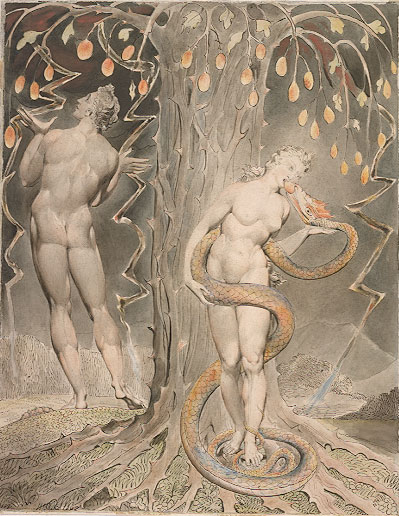
Satan's most dangerous attack


Temptation and the Fall of Eve by William Blake
Homily: 10th Sunday in Ordinary Time – Cycle B
          Although we’ve been back in “Ordinary Time” for a couple of weeks now, we’ve been occupied with the celebrations of Trinity Sunday and Corpus Christi.  This weekend, we celebrate the first “ordinary” Sunday in Ordinary Time since February 11th.  As we know, Ordinary Time is the time for us to focus on growing as disciples of Christ.  One of the ways that we do that is to identify and remove any obstacles to our discipleship.  Interesting, therefore, that our scriptures today speak a lot about the enemies of God and their influence in the world.  Perhaps, therefore, we can take a moment to talk about the ways that Satan attacks us.  In doing so, hopefully we’ll all be a little less fearful of these ways and, thus, strengthened to resist Satan and his influence as we strive to grow and live as disciples of Christ.
          Satan attacks us in many ways: some of them quite dramatic and frightening.  The rarest, yet most dramatic of these of is demonic possession.  This is where an evil spirit gains access to control a person’s body.  Almost always this occurs when someone gets involved with the occult, spiritsm, or witchcraft (Ouija boards included!).  There’s the old legend that a “vampire can’t enter your house unless you invite him.”  The invitation that one gives to an evil spirt isn’t always explicit, but when participating in these “dark arts” activities, the door is opened and a “Welcome” mat is laid out.
          One who has been possessed by an evil spirit will then begin to experience “crises”, in which the evil spirit temporarily takes control of the person’s body and can manifest certain phenomena, such as: extraordinary physical strength and speaking and understanding languages that the person never studied.  To free the person of this evil spirit, the Church offers exorcism.  Exorcism consists of a series of prayers and sacramentals performed by a priest who has been specially trained and designated by the bishop.  This ritual makes the demon suffer so much that, eventually (and if the person is cooperative) the demon will just give up and leave.  Although Hollywood tends to overdramatize the acting out of these rituals, they are, nonetheless, dramatic.  Thankfully, however, the need for such exorcisms is much rarer than Hollywood would like you to believe.
          Besides possession, there are also some other extra-ordinary ways that Satan attacks us.  Sometimes, Satan and his fallen angels cause frightening physical disturbances in certain places or even to our own bodies.  These can take the forms of loud or strange noises, slamming doors or windows, being moved around physically by an invisible force, or even more alarming effects.  When these physical disturbances are concentrated in certain places (a home or a room), they are called demonic infestation.  When they directly affect someone's body (not from within, as in possession, but from the outside) they are called demonic oppression.  When they bother someone's mind (filling it constantly with blasphemous thoughts), they are called demonic obsession.  Blessings, holy water, and other prayers and sacramentals are strong defenses against these kinds attacks.
          These extra-ordinary kinds of attacks are, of course, dramatic and frightening.  But they are much, much less frequent, and much, much less dangerous than the Satan’s favorite tactic for attacking us.  What is it?  Temptation.  While possession, infestation, oppression, and obsession can frighten us (and potentially cause us to lose faith in God), they usually lead us to exercise our faith in order to be rid of them.  Temptation, on the other hand, tries to lead us into sin; and sin is the only thing that separate us from God.  Thus, while much less frightening (in fact, it’s often quite the opposite!), temptation is much more dangerous.
          If we need an example of this, just look at Adam and Eve.  Satan did not possess them, he did not make the trees dance around inexplicably, he didn’t bully them (pushing them around or disturbing their sleep), and he didn’t assail them constantly with thoughts of cursing God.  Rather, he tempted them.  He tempted them to doubt God’s truthfulness and they took the bait.  Having no other reason to keep from eating the fruit of that tree than that God had said not to, Eve perceived no harm could come from it and so took the fruit and ate it; and Adam after her.  Their blindness then removed, however, they could see the truth of what had happened and so felt ashamed.  When God came looking for them, they hid not because they were naked (although that is the excuse Adam used), but because they didn’t want to face God, whose trust they had betrayed.
          What happens next in the reading, however, leaves me feeling a bit jealous of Adam and Eve.  God’s punishment against the serpent was that there would be “enmity” between him and Eve: meaning that Eve would now be frightened to see the serpent, so that she would never trust him or his temptations ever again.  In other words, Adam and Eve would know their tempter and so be better equipped to resist the temptations.
          We are not so lucky.  When we are tempted, quite rarely is our tempter visible to us.  If he is, it is usually someone who seems rather friendly or trustworthy.  It would be so much easier if all our tempters were repulsive to us, right?, like the serpent was made repulsive to Eve.  Still more, because of our fallen nature, we suffer from a disordered desire for the things of this world (which our tradition calls “concupiscence”).  In this case, all we have is the forbidden fruit before our eyes, which looks “pleasing to the eyes”, and which, perhaps, has never been explicitly declared to be “forbidden”, and an urge to take it.  Adam and Eve had a lot more going for them and they still fell into sin.  Given our situation, then, our efforts to resist temptation might seem hopeless.
          For the Christian, however, it is not hopeless; and Jesus’ parables in the Gospel reading show us why.  In today’s reading, Jesus was accused of being possessed by the devil or being in “cahoots” with the devil himself.  Jesus condemns those calling him possessed: for in calling him “possessed by an evil spirit”, they were accusing the Holy Spirit of being evil (which is the unforgivable “sin against the Holy Spirit” about which he spoke).  Then he gives two parables to prove that he is not on Satan’s “team”, but rather stands against him.  The first using logic to say that a kingdom divided cannot stand; and so, if he is on Satan’s “team”, then don’t worry because Satan will soon fall.  The second to illustrate what he is actually doing:  Jesus is the one who has come to tie up the “strong man” (that is, Satan) so that he could “plunder his property” (that is, take back the souls of God’s children).
          This, then, is the reason for our hope: that when we can’t see the tempter working his wiles on us (either because he takes the form of someone seemingly trustworthy or because he introduces sinful thoughts), we nonetheless have the power of Christ available to us and his example of self-sacrifice to guide us to choose God’s will over our own, sinful inclinations.  Christ will bind the “strong man” once again when we call on him in temptation so that we might be liberated from his grasp.
          Still, we have to do our own work: that is, we must pray, frequent the sacraments (especially the Eucharist and Reconciliation), and we must practice virtue in our daily actions.  In doing these things, temptations will become increasingly repulsive to us, because we will be seeing the one who is tempting us, the serpent from the Garden, and we will be strengthened to overcome them.  This, my friends, is our “Ordinary Time” work: to make temptations repulsive so that we can stay focused on Jesus.  Let us take up this good work, then, trusting that God, who has begun this good work in us, will bring it to completion.
Given at All Saints Parish: Logansport, IN – June 9th & 10th, 2018

Monday, November 20, 2017

Being Christ's worthy spouse

Homily: 33rd Sunday in Ordinary Time – Cycle A
          Perhaps many of us have read the books, or seen the films, of C. S. Lewis’ The Chronicles of Narnia.  Many readers have concluded that his stories fall into the category of “Christian allegory.”  Now, an allegory is a literary device—a tool of communication—in which metaphors are used to explain an abstract idea through storytelling.  In the case of Lewis’ books, the fantasy world of Narnia is used to illustrate some of the fundamental truths of the Christian faith: most notably, the battle between good and evil that rages within and around each one of us, and the presence of a powerful king—Aslan—who leads us and inspires in us the faith to persevere in the battle.  Parables are very similar to allegories in that they use metaphorical images in storytelling as a way of imparting certain ideas.  The difference is that parables are usually much shorter and focused, perhaps, on a particular moral lesson that the author is trying to impart.  In a sense, parables are “Allegory Lite.”
          In the Gospel reading today (and, for that matter, the last couple of weeks), Jesus tells his disciples a parable.  Most of us, I would guess, are quite familiar with this parable and so the meaning of the metaphors the parable utilizes probably shine through.  The Master—who is Jesus—is going on a journey to be seated at the Father’s right hand and so needs to entrust his possessions—which is the Gospel—to his servants—otherwise known as his disciples—to care for them until he returns. After a long time—perhaps 2000 years or more—the master will return and call in his servants to see if they’ve been profitable with what they were entrusted.  Those who return with a profit proportional to what they were given—perhaps a number of converts to the faith or a faithful family or works that have helped the poor—those will be blessed for their faithfulness.  Those who failed to be profitable with what they were given—perhaps out of fear, indifference, or even spite—they will be punished for their unfaithfulness.
          For the disciples to whom this parable was first addressed, I suspect the allegory was obvious and the meaning clear: “We better get out and spread the Gospel so we aren’t caught having done nothing when Jesus returns.”  And I suppose that it’s not much of a stretch for us to interpret the allegory in the same way: “Jesus, it seems, is long delayed, but the fact of the matter is that he could still return at anytime, so we better ‘make hay while the sun shines,’” and that’s easy enough.  Well, perhaps it’s a bit too easy.
          I think, perhaps, that it is too easy to see God as “master” and ourselves as “servants.”  When we look at it this way, it’s kind of easy to fall into a “just do the minimum” mindset exemplified by such “bumper sticker wisdom” as: “Jesus is coming, look busy.”  Such “wisdom” plays on our very natural inclination—which, in fact, is a disordered inclination—to do only what’s minimally necessary so that when our “master” returns we look like we’ve done something when really we’ve done nothing at all.  It’s the mindset that thinks that we can somehow “pull the wool” over the eyes of Jesus to make him believe that we were faithful even when we haven’t been (which, in itself, is a nice piece of irony considering that Jesus is the Lamb of God).
          This “just follow the rules” mindset, of course, is not what God has called us to.  Saint Paul is adamant about this, stating repeatedly in his letters that if being a follower of Christ is just about the rules, then forget about it, it’s useless.  Saint Paul knew that when Jesus said, “I no longer call you servants, but friends,” he was inviting us to a relationship beyond that of a master and his servant: a much deeper relationship that brings with it greater responsibilities.
          In our first reading today, we hear a description from the book of Proverbs—an Old Testament “wisdom” book—of a woman described as a “worthy wife.”  I suppose it would be easy to look at this reading and dismiss it as an outdated description of an “ancient middle-eastern housewife” that has no relevance for us today.  Our Catholic faith, however, tells us that Sacred Scripture is God’s living Word—Jesus Christ—speaking to us and revealing himself to us, and so perhaps if we feel inclined to think that a piece of the Scriptures has no relevance for us we need to think again, and maybe become a little curious about why these words were preserved for us to read and ponder here today.  What I would challenge all of us here today to see in this reading is another allegory—one a little less obvious, perhaps, but no less profound.
          The reading tells us that when a man finds a worthy wife, he entrusts his heart to her, and that the worthy wife responds to this trust by working with loving hands to bring him good and not evil.  How often we forget that Jesus is not just our master and we his servants, but that Jesus is also the bridegroom and we—his Church—are his bride.  This is a much more intimate image.  Thus this reading becomes very relevant to our lives today and shows us how we, entrusted with the heart of Jesus, ought to respond so as to be a worthy spouse of so great a husband.  In fact, it shows us the only way, really, that we can respond, given our human limitations: that is, by bringing him good and not evil in our daily actions and by working with loving hands to serve him and each other.
          My brothers and sisters, Jesus has found a worthy spouse—his Church, that is, all of us—and he has entrusted to her his heart—his very Self—here in the Eucharist.  No doubt, it is a fearful thing to be entrusted with so great a gift.  We need not be fearful, however, as if our Master seeks only to catch us off guard in order to punish us.  Rather, we can be hopeful, trusting that the one who has entrusted his heart to us seeks only our own good and to find us faithful.  It is this hopeful trust, then, that leads us to a faithful, fruitful, and joy-filled living of the mystery that God has given to us—a living that can begin here today.  May this mysterious love overflow in our hearts and touch the lives of all those around us.

Given at All Saints Parish: Logansport, IN – November 19, 2017

Sunday, November 12, 2017

"Be Prepared"


Homily: 32nd Sunday, Ordinary Time – Cycle A
          Although I was never a Boy Scout, I nevertheless have always remembered their simple motto: “Be prepared.”  This simple motto is meant to remind young boys of the need to be ready to handle unexpected situations, when they occur.  For example, a young man hiking in the woods should be prepared with a compass and a flashlight in case he finds he has lost the trail.  Similarly, he should be prepared with extra food in case adverse weather strands him at a campsite for an extra day or two.  Still further, he should be prepared to assist in adverse situations like, for example, if he encounters a car accident and other emergency personnel have not yet arrived.  This simple, practical advice is nothing new, of course.  The Boy Scouts are simply adapting time-honored wisdom to help boys learn how to be responsible young men, which hopefully will translate into their involvement in their communities.
          For the virgins in our Gospel reading today, we see how this notion of preparedness rings true.  Five of the virgins, we are told, had taken thought of wisdom and thus acted prudently when they went out to wait for the bridegroom to return with his new bride.  Even though the reading doesn’t tell us this, I would guess that, like the foolish virgins, these wise virgins thought it was unlikely that the bridegroom, even if he was delayed, would return in the middle of the night.  Nevertheless, they didn’t presume to know for sure and so prudently brought with them extra oil for their lamps, realizing that it was better to have it and to be prepared than to be caught without it.
          The five foolish virgins, on the other hand, presumed just the opposite.  Instead of considering the possibility of a long wait or of the bridegroom returning in the middle of the night, they simply joined the vigil, lamps in hand, but without any extra oil to fuel them if the unexpected happened.  Thus, even though both the wise and the foolish virgins were surprised by the bridegroom’s return at midnight, only the wise, who were prepared to welcome him at this unlikely hour, were able to join the wedding feast.
          We, too, often find ourselves to be victims of this kind of presumption.  In our modern culture, particularly here in the United States, there is a certain cultural phenomenon occurring called “the tyranny of the urgent.”  Increasingly, people are allowing their lives to be driven by “urgent” tasks that seemingly cannot be put off until later.  For example, when business emergencies lead a parent to cancel a family vacation or to spend more time at work than at home, then it becomes apparent that the “urgency” of this person’s work is controlling his or her personal life, in some sense like a tyrant.  The result of this phenomenon is that people have begun to lose sight of long term goals and thus are failing to prepare for them.  A popular song in the nineteen-eighties pronounced that “everybody is working for the weekend.”  Such a “short term” view fails to recognize the need to be prepared for unexpected problems in the future.
          Probably the thing that is easiest for us to lose sight of—the thing that seems to be the least urgent—is the return of Christ.  For nearly two-thousand years, Christ has been “ascended into heaven” and is “seated at the right hand of the Father.”  Thus, for us it probably seems impossible that Jesus would just return without any warning—without some sort of prolonged sign—that would give us a chance to prepare ourselves to celebrate his return.  Yet, this is exactly the same presumption that the foolish virgins made, isn’t it?  We presume, exactly like they did, that, since he is long delayed in returning, he will not come at the unexpected time of midnight, but rather at a convenient time, when we can expect him, thus giving us time to put off our preparations.  As we saw in the parable of the virgins, however, this is a very dangerous presumption to make.
          What the wise virgins recognized but the foolish virgins failed to recognize was that everything that they needed in order to be prepared was readily available to them.  The merchants, it seemed, had no shortage of oil.  In fact, it appears that there were even “all-night” merchants, who were ready to sell the foolish virgins oil for their lamps even after midnight (the ancient equivalent to the modern convenience store).  This is to show that no one was trying to prevent any of the virgins from joining into the wedding feast, but rather that all that they needed to be prepared was readily available to them.  The grace, of course, comes when one takes advantage of the resources available to him or her.  Thus, the wise virgins who took advantage of what was available to them were rewarded for their prudence by being welcomed into the wedding feast.
          In the same way, when it comes to having the resources that we need to be prepared for the second coming of Christ, God has no less provided.  He has given us the sacraments as a way to stay connected to Christ’s Body and thus to prepare us for the day when he comes again.  Through Baptism, as well as Confirmation and Holy Communion, we are initiated into the Church as members of Christ’s body.  Through the sacrament of Reconciliation, we are healed and restored as members even after we’ve separated ourselves from it by sin.  Our weekly celebration of the Eucharist fills our flasks with oil and keeps us alert so that we are ready for the unexpected moment when Christ will come to take us, his Church, home to the eternal banquet in heaven.  Yes, these sacraments are instruments of God’s grace that connect us to him.  They make us “recognizable” to him so that when he comes again, he will invite us into the heavenly banquet.  Thus, it is the truly wise who take advantage of them.
          My brothers and sisters, as we approach the end of this liturgical year, we are being reminded to think about the promise that still awaits us—the eternal banquet in heaven—and of the need to “Be Prepared”—that is, to remain watchful and ready for when that day comes—for the Kingdom of Heaven will appear when we least expect it.  Thus, the question we might ask ourselves this week is, “How much oil is in my lamp?”  Whatever your answer may be, let us remember that, here today, we have an opportunity to fill our lamps with the grace offered to us from this altar: the Body and Blood of Christ, our Savior.

Given at All Saints Parish: Logansport, IN – November 12th, 2017

Monday, October 16, 2017

The wedding banquet is prepared and you're invited!

Homily: 28th Sunday in Ordinary Time – Cycle A
          Friends, in this reading that we have just heard, Jesus is once again using a parable to demonstrate an important point; and we remember that these parables are really allegories: symbolic stories using familiar images to reveal a hidden reality.  In this particular allegory, Jesus is attempting to teach the Jewish religious elite that they are about to lose the favor they had with God because of their failure to respond to his call.  Let’s take a closer look at this parable.
          The king who prepares the wedding feast is obviously God and his son is obviously Jesus, the Second Person of the Holy Trinity: God’s “only begotten Son”.  The wedding feast is obviously the banquet of the Eucharist (although the Jewish religious elite of the time would not have known that as we know it: they would have only thought of a great, continual feast that would be celebrated when the Messiah would come and conquer all of their enemies; still they would have understood the wedding feast/banquet imagery).  The invited guests are God’s chosen people, the descendants of the ancient Israelites: the Jews.  The king’s servants who go to call the invited guests are the prophets; and the “bad and the good” who were then invited in the place of God’s chosen people are the Gentiles: that is, the people of all the nations that weren’t part of the ancient Israelite ancestry.
          The parable, of course, is a warning to the Jewish religious elite that their pride in their religious authority, which led them to ignore, at best, and mistreat, at worst, God’s prophets, would soon be their downfall.  Not only would their enemies come and destroy them and burn their city (which really happened, by the way, in 70 AD when the Romans sacked Jerusalem), but their status as a chosen people would no longer be exclusive; rather, it would be extended to the Gentiles: peoples who would gratefully receive it.
          While it certainly would be easy for us to sit back after hearing this parable again and say “Haha, those guys sure messed up didn’t they?” I think that it would be foolish for us not to take it as a warning for ourselves, here and now.  Yes, we, who are sitting here, are the “Church of the Gentiles”, who are the beneficiaries of the complacency of the ancient Jews, but I wonder if we haven’t become complacent, ourselves.  One of the most disturbing statistics about Catholics in recent years has been that less than 25% of those who declare themselves Catholic attend Mass on a regular basis.  Notice that we’re not talking about all baptized Catholics, because many baptized Catholics no longer declare themselves to be Catholic.  Rather we’re talking about those who still consider themselves to be Catholic and that 75% of these persons are so complacent about what it means to be Catholic that they no longer consider it a necessary part of their Catholicism to attend Mass.  Not to mention the fact that many Catholics who do attend Mass with some regularity feel little remorse for having missed Mass on any given occasion (I sit in that confessional, so I know).  Couple this with the fact that I’ve already discussed—that the wedding feast described in Jesus’ parable is an image of the Eucharist that we, as Catholics—the Gentile Church—celebrate—and all of a sudden this parable looks like it might be aimed squarely at us.
          My friends, the Eucharist—the wedding feast that God, our king, has prepared for his Son, Jesus, and to which we have been invited—is the greatest and most generous gift God has (and will) ever offer to us.  It is both the source of our entire Christian life (that is, the “spring of living water” from which all Christianity flows) and it is its summit of that life (that is, the end to which all Christianity leads).  To deny this is to deny the Christian faith.  And, thus, to disregard the Eucharist as something “disposable” in the Christian faith is to offend God at the level that the king in Jesus’ parable was offended when his invited guests all greatly disrespected his son by finding excuses for not attending his wedding feast.  Please tell me, who among you would not exclude from your friendship a so-called “friend” who offended you in such a great way?
          My brothers and sisters, if we, in any way, hold this attitude (that is, that the Eucharist is a “disposable” part of our faith), then we must purge that idea from our minds and our hearts we must and ask God for the grace to receive this gift of the Eucharist as the most precious gift we have ever received in our lives.  And if we know someone—especially someone who still considers themselves to be Catholic—who has so discarded this gift that he / she doesn’t attend Mass, then we must find ways to express to that person what a great gift the Eucharist is, and, thus, invite them back to this source and summit of their Christian faith.  And why?  So that God does not decide to treat us like he treated those ancient Jews and turn from us in order to invite those who will truly be grateful for the gift he is offering.
          My friends, if we need any evidence that the Eucharist is the greatest gift that God has (and will) ever offer to us, we should look no further than to those who have converted to the faith.  While the desire for the Eucharist may not have been the thing that brought them to the Church, I have found that, once they understand it, it becomes the thing that keeps them in the Church.  They are signs to us that God continues to “send his servants out into the streets” to invite the “Gentiles” and reminders to us that God will not tolerate our complacency when it comes to his generosity.  Therefore, as we welcome our sister Patty to share in this Great Wedding Feast for the first time, let us renew in our own hearts our gratitude for being among the invited so that we might give worthy thanks to God, our Father: both here in this Mass and by our lives of faithful discipleship in the world.

Given at All Saints Parish: Logansport, IN – October 15th, 2017

Monday, October 9, 2017

Gratitude: A sure guarantee of fruitfulness

Homily: 27th Sunday of Ordinary Time – Cycle A
          Growing grapes for producing wine is a process that requires meticulousness and patience.  When starting up a new vineyard, one has to wait at least a couple of years for the first “sweet” grapes, good for making wine, appear.  For the “richer flavor” grapes, one has to wait five or more years; and if anything harsh happens in between (like a hard frost in late spring) the wait is even longer.  It’s a labor that can only really be taken up by one who is less concerned about making a profit than about producing a good fruit.
          Perhaps this is what makes the image of the vineyard and the vinedresser such a popular one for parables in the Scriptures.  In the ancient near east there were vineyards everywhere, which made this image very accessible to just about everyone.  And, because it presents an image of someone who oversees and diligently cares for creation, it is also an appropriate image for describing God’s involvement in our lives.  Today our scriptures offer us two different parables using the same image that help us to shed light on our relationship with God and the stewardship that he has given to us.
          In both parables, God is portrayed as the dutiful owner of the vineyard who does everything in his power to provide the perfect environment for the vines to grow and produce a good fruit.  Not only does he cultivate the land meticulously, but he also places a hedge around it to protect it; and he even digs a wine press in it, in anticipation of the good fruit that he expects the vines will produce.  In short, he does everything any good vinedresser would do who wants to ensure a good harvest of fruit.
          In Isaiah’s parable, we find that the owner of the vineyard, when he comes in search of fruit from his vines, finds not the good, sweet grapes ready for the press, but rather wild, bitter grapes which are no good for anything except to be thrown out.  In the parable the vineyard owner asks “What more could I have done?”  The implied answer is, of course, “nothing.”  This also implies that the failure to produce a good fruit is not the fault of the owner, but rather the fault of the vines themselves and it is meant to be a conviction against the Israelite people who had failed to keep God’s commandments, thus creating a society full of corruption in which the poor suffer the most.  For this, the prophet warns them, the Lord will take away his protection from them and they will fall victim to the militant nations that surrounded them.
          It should not be hard for us to see ourselves in this parable.  Who here hasn’t been the recipient of God’s gracious protection?  And who here, at some point in your life, hasn’t found yourself turning your back on God’s commands, instead feeding your passions and, thus, producing “bitter fruit”?  In greater and lesser degrees, we probably still find ourselves “producing bitter fruit” instead of the rich harvest for which the Lord created us.  And is this because the Lord hasn’t provided everything for us?  No!  Rather it is our own human weakness and tendency to use our free will for our own selfish ends that produces such bitter fruit.  Thus, this parable today should also be a renewed call to each of us to turn from our selfish ways—daily if necessary—and to seek first the building of God’s kingdom.
          In Jesus’ parable in the Gopsel, we find that the owner of the vineyard, after securing a good harvest of grapes, goes on a journey and leaves his vineyard to others to tend in his absence.  When the owner sends his servants to bring him his harvest, the tenants turn against them: hoping to seize the harvest for themselves.  Showing an incredible amount of patience with these rebellious tenants, the owner sends other servants, and then his own son, hoping that the tenants will rethink their rebellion and turn over the harvest.  These they also kill, as their greed for the harvest so overcomes them that they become blind to the certain consequence of their actions.  The chief priests and elders name this consequence: the tenants themselves will be killed and the vineyard will be given over to others who will be loyal to the owner and give him the produce that is rightfully his.  Ironically, Jesus issues this as a warning to the religious elite, the same chief priests and elders, who have seized the Lord’s vineyard—his chosen people—for themselves; thus betraying the stewardship that they had been given.
          For us this is also a warning.  As baptized Christians we have all been given a stewardship in the Lord’s vineyard to tend his vines and produce a harvest of fruit when the Lord comes to seek it.  If we simply come here week after week to “feed off of the grapes” but fail then to go forth from here to preach the good news of salvation, to bring others to Christ, and to work for justice, then we are no better than the wicked tenants who refused to hand over to the vineyard owner the good fruit that he had worked so hard to produce.  Thus we also condemn ourselves to the same disastrous fate that those wicked tenants would suffer: to be cast out of the kingdom of God into the hell of eternal death.
          Now it seems to me that, in both of these cases, there is one common thing that is missing that leads each of these groups of people into their rebellion against God; and I think that if we consider what they were missing in the light of our own rebellions against God we, too, will find the same thing missing.  What is this thing?  Gratitude.  Why did ancient Israel rebel against God and produce the bitter fruit?  Because they took God’s graciousness to them for granted instead of remaining thankful for His vigilant care.  Why did the chief priests and the elders act as they did to the prophets of God and to God’s Son himself?  Because they allowed themselves to become blinded by the authority they held instead of remaining thankful for the stewardship that had been given them.  And why do we still sin against God?  Well, because it’s easier, right?  And why do we choose the easy way?  Because we forget God’s graciousness to us—and, thus, our debt to him—and so we use the gifts that he has given us to pursue our own selfish ends; producing bitter fruit and failing in the stewardship with which we have been entrusted.
          My brothers and sisters, examine your lives and see if this isn’t true: that whenever we fail to give thanks for the graciousness given to us we become bitter and self-absorbed; but when we give ourselves to gratitude we become gracious and more focused on others.  It is for this very reason that we gather each Sunday to celebrate the Eucharist: to remind us of our need to give thanks for all that God has done for us—most especially the gift of life and for the redemption won for us in Christ Jesus—and to receive the grace to go forth from here to fulfill the stewardship entrusted to us: to be missionary disciples for the building of God’s kingdom, his vineyard, so that a rich harvest of souls might be produced.
          You know, it’s no coincidence that the Scriptures are full of images of vineyards and that we offer the fruit of the vine as part of our thanksgiving offering here on this altar.  And so, my brothers and sisters, may our offering this day—and every day—be the sweet fruit of gratitude for all that God has done for us in Christ Jesus; and may we carry that gratitude forward to bring God’s blessings to the world around us.

Given at All Saints Parish: Logansport, IN – October 8th, 2017