 |
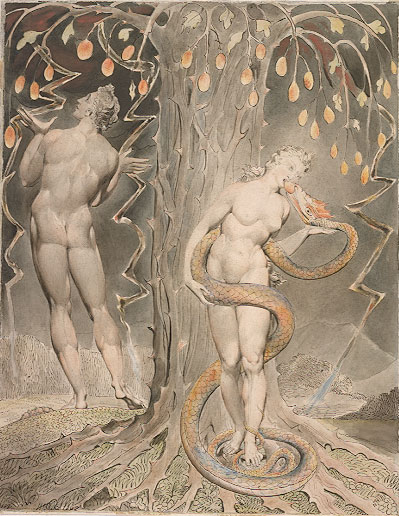
| Temptation and the Fall of Eve by William Blake |
Although
we’ve been back in “Ordinary Time” for a couple of weeks now, we’ve been
occupied with the celebrations of Trinity Sunday and Corpus Christi. This weekend, we celebrate the first
“ordinary” Sunday in Ordinary Time since February 11th. As we know, Ordinary Time is the time for us
to focus on growing as disciples of Christ.
One of the ways that we do that is to identify and remove any obstacles
to our discipleship. Interesting,
therefore, that our scriptures today speak a lot about the enemies of God and
their influence in the world. Perhaps,
therefore, we can take a moment to talk about the ways that Satan attacks us. In doing so, hopefully we’ll all be a little
less fearful of these ways and, thus, strengthened to resist Satan and his
influence as we strive to grow and live as disciples of Christ.
Satan
attacks us in many ways: some of them quite dramatic and frightening. The rarest, yet most dramatic of these of is
demonic possession. This is where an
evil spirit gains access to control a person’s body. Almost always this occurs when someone gets
involved with the occult, spiritsm, or witchcraft (Ouija boards included!). There’s the old legend that a “vampire can’t
enter your house unless you invite him.”
The invitation that one gives to an evil spirt isn’t always explicit,
but when participating in these “dark arts” activities, the door is opened and
a “Welcome” mat is laid out.
One
who has been possessed by an evil spirit will then begin to experience “crises”,
in which the evil spirit temporarily takes control of the person’s body and can
manifest certain phenomena, such as: extraordinary physical strength and speaking
and understanding languages that the person never studied. To free the person of this evil spirit, the
Church offers exorcism. Exorcism
consists of a series of prayers and sacramentals performed by a priest who has
been specially trained and designated by the bishop. This ritual makes the demon suffer so much that,
eventually (and if the person is cooperative) the demon will just give up and
leave. Although Hollywood tends to
overdramatize the acting out of these rituals, they are, nonetheless,
dramatic. Thankfully, however, the need
for such exorcisms is much rarer than Hollywood would like you to believe.
Besides
possession, there are also some other extra-ordinary ways that Satan attacks
us. Sometimes, Satan and his fallen
angels cause frightening physical disturbances in certain places or even to our
own bodies. These can take the forms of
loud or strange noises, slamming doors or windows, being moved around
physically by an invisible force, or even more alarming effects. When these physical disturbances are
concentrated in certain places (a home or a room), they are called demonic
infestation. When they directly affect
someone's body (not from within, as in possession, but from the outside) they
are called demonic oppression. When they
bother someone's mind (filling it constantly with blasphemous thoughts), they
are called demonic obsession. Blessings,
holy water, and other prayers and sacramentals are strong defenses against
these kinds attacks.
These
extra-ordinary kinds of attacks are, of course, dramatic and frightening. But they are much, much less frequent, and
much, much less dangerous than the Satan’s favorite tactic for attacking us. What is it?
Temptation. While possession,
infestation, oppression, and obsession can frighten us (and potentially cause
us to lose faith in God), they usually lead us to exercise our faith in order
to be rid of them. Temptation, on the
other hand, tries to lead us into sin; and sin is the only thing that separate
us from God. Thus, while much less
frightening (in fact, it’s often quite the opposite!), temptation is much more
dangerous.
If
we need an example of this, just look at Adam and Eve. Satan did not possess them, he did not make
the trees dance around inexplicably, he didn’t bully them (pushing them around
or disturbing their sleep), and he didn’t assail them constantly with thoughts
of cursing God. Rather, he tempted them. He tempted them to doubt God’s truthfulness
and they took the bait. Having no other
reason to keep from eating the fruit of that tree than that God had said not
to, Eve perceived no harm could come from it and so took the fruit and ate it;
and Adam after her. Their blindness then
removed, however, they could see the truth of what had happened and so felt
ashamed. When God came looking for them,
they hid not because they were naked (although that is the excuse Adam used),
but because they didn’t want to face God, whose trust they had betrayed.
What
happens next in the reading, however, leaves me feeling a bit jealous of Adam
and Eve. God’s punishment against the
serpent was that there would be “enmity” between him and Eve: meaning that Eve
would now be frightened to see the serpent, so that she would never trust him
or his temptations ever again. In other
words, Adam and Eve would know their tempter and so be better equipped to
resist the temptations.
We
are not so lucky. When we are tempted,
quite rarely is our tempter visible to us.
If he is, it is usually someone who seems rather friendly or trustworthy. It would be so much easier if all our tempters
were repulsive to us, right?, like the serpent was made repulsive to Eve. Still more, because of our fallen nature, we
suffer from a disordered desire for the things of this world (which our
tradition calls “concupiscence”). In
this case, all we have is the forbidden fruit before our eyes, which looks “pleasing
to the eyes”, and which, perhaps, has never been explicitly declared to be “forbidden”,
and an urge to take it. Adam and Eve had
a lot more going for them and they still fell into sin. Given our situation, then, our efforts to
resist temptation might seem hopeless.
For
the Christian, however, it is not hopeless; and Jesus’ parables in the Gospel
reading show us why. In today’s reading,
Jesus was accused of being possessed by the devil or being in “cahoots” with
the devil himself. Jesus condemns those
calling him possessed: for in calling him “possessed by an evil spirit”, they
were accusing the Holy Spirit of being evil (which is the unforgivable “sin
against the Holy Spirit” about which he spoke).
Then he gives two parables to prove that he is not on Satan’s “team”,
but rather stands against him. The first
using logic to say that a kingdom divided cannot stand; and so, if he is on
Satan’s “team”, then don’t worry because Satan will soon fall. The second to illustrate what he is actually
doing: Jesus is the one who has come to
tie up the “strong man” (that is, Satan) so that he could “plunder his property”
(that is, take back the souls of God’s children).
This,
then, is the reason for our hope: that when we can’t see the tempter working
his wiles on us (either because he takes the form of someone seemingly
trustworthy or because he introduces sinful thoughts), we nonetheless have the
power of Christ available to us and his example of self-sacrifice to guide us
to choose God’s will over our own, sinful inclinations. Christ will bind the “strong man” once again
when we call on him in temptation so that we might be liberated from his grasp.
Still,
we have to do our own work: that is, we must pray, frequent the sacraments
(especially the Eucharist and Reconciliation), and we must practice virtue in
our daily actions. In doing these
things, temptations will become increasingly repulsive to us, because we will
be seeing the one who is tempting us, the serpent from the Garden, and we will
be strengthened to overcome them. This,
my friends, is our “Ordinary Time” work: to make temptations repulsive so that
we can stay focused on Jesus. Let us
take up this good work, then, trusting that God, who has begun this good work
in us, will bring it to completion.
Given at All Saints Parish: Logansport, IN – June 9th
& 10th, 2018
