Showing posts with label retreat. Show all posts

Sunday, September 22, 2019

Engage the world and build the kingdom


Homily: 25th Sunday in Ordinary Time – Cycle C
Just about halfway through my time in seminary, when I was in my first year of theology studies, our annual retreat was to be a silent one at a retreat house run by the Ursaline Sisters near Owensboro, Kentucky.  Their house was outside of the city, right next to a farm.  It was early spring and so cool temperatures were still the norm.  Nonetheless, I made it a point to get outside each day and walk.  I was struggling with my vocation at that point and spent a lot of time on that retreat praying about whether or not this was really the vocation to which God was calling me.  Part of the farm was cow pasture and I remember sitting and watching the cows near the end of the day one day and thinking that this stressful life of preparing for a stressful life of ministry was for the birds; and I longed for a more simple life—like one I imagine I could find on a farm—in which my work would be clear and I could put in an honest day of work, every day, and return home to peace and tranquility.
I became somewhat convicted by this idea and so decided to speak about it to my spiritual director for the retreat.  He was one of the monks from Saint Meinrad, Fr. Guerric.  Fr. Guerric is originally from the East Coast (New York or New Jersey, I can’t remember) and his accent shows it.  He also has a great “East Coast” way of telling you what he thinks: which means, straight in your face.  Thus, when I revealed to him that I was becoming more and more convinced that a life of ministry wasn’t my call, but rather a life of simple labor and quiet simplicity, his response was... how should I say it... direct.  “Oh, get over yourself, Dominic! That is not what God has called you to do”, was his response.  He could see right through my over-romantic notion: primarily because it involved giving up on the world; and he knew that a true vocation is never one that leads someone to give up on the world, but rather one that leads someone to give him/herself more fully for the world.  My frustration with dealing with the world, therefore, was no sign that I was wrong about my vocation; but rather a good sign that I was on the right path. (“Spoiler alert”: I think that you all know the rest of this story, because here I am today...)
In our Gospel reading today, Jesus presents a somewhat troubling parable.  There a household steward (today we might call this person a “personal asset manager”) is about to be fired for not doing his job well.  This causes him great consternation, of course, since he realizes that he’s about to lose his livelihood and be out on his rear end.  He knows that manual labor is not for him and so he devises a plan: “I’ll garner favors with my master’s debtors so that one of them will take me in once I’m homeless and so I won’t have to resort to manual labor.”  Two great ironies emerge: 1) the bad steward suddenly shows talent and the ability to work an advantageous deal as soon as his meal ticket is on the line, and 2) the master, who is getting ready to fire him, actually commends him for these “slick moves”.  In both, Jesus seems to be presenting this in such a way as to show this steward in a favorable light.  Our minds kind of automatically rebel against the idea of commending someone who is dishonest, however, so it begs the question: what is the point?
The point, it seems, that Jesus is trying to make to his disciples is that they must learn to be shrewd in their dealings with the world.  Jesus knew that his disciples would be sent out to proclaim this Gospel message in the everyday life of society; and that, if they weren’t shrewd in dealing with the world, then they would be ineffective and, thus, fail in their mission (for even those who are dishonest show themselves to be shrewd in dealing with the world… as the dishonest steward was).  In fact, in the early centuries of the Church, sects called “gnostics” promoted that the goal of life was “mental enlightenment”, after which one no longer really needed to deal with the world: because, through enlightenment, they would be living on a “higher” plane.  Jesus’ teaching squarely contradicts this, however, when he says, “Make friends for yourselves with dishonest wealth”, meaning, “Deal shrewdly with this world and its riches”.  In other words, it’s as if Jesus is saying, “I am not calling you to remove yourselves from the world, but rather to go out into it—dealing with it prudently, of course, yet nonetheless dealing with it—so as to bring this message of salvation to all peoples.”
Friends, we have to remember that Christianity is a religion: which means that, in part, it is a way of living in and interacting with the world.  This as opposed to a cult: which typically demands that people separate themselves from the world and from interacting with it.  Because of this, we need to heed Jesus’ words and not try to pull back from the world (like I tried to do during that retreat, ten years ago), but rather to engage the world and deal shrewdly with it.  This is what I feel like the Uniting In Heart 2030 Pastoral Plan does for us: as a diocese, it provides us with a roadmap of how to be more shrewd in how our parishes live in and interact with the world, which will allow us to be more effective in fulfilling our mission to proclaim the Good News of eternal life through Jesus.
My brothers and sisters, Jesus, the Master, is calling us to be good stewards of his household, the Church.  The parable of the dishonest steward is a warning and a challenge: a warning not to get lazy in our stewardship and risk losing our position all together, and a challenge, thus, to deal shrewdly in the world, while we are in it, so as to build up the Church and prepare for our Master’s coming (and for the accounting to which he will call us when he comes).  Uniting In Heart 2030 is a chance for us to renew and strengthen our stewardship of God’s household; and so I hope that you will all join me in committing yourself to doing what will be necessary to see it come to fruition for Christ and his Church.
It is true what Saint Paul said in his letter to Timothy, that “God wills everyone to be saved and to come to knowledge of the truth.”  Therefore, strengthened by this Eucharist, let us take up this good work so that more and more men and women can come to know Christ and his salvation; and that we, too, can be well prepared to enter the “eternal dwellings” that Christ, our Savior, has prepared for us.
Given at Saint Mary’s Parish: Lafayette, IN – September 22nd, 2019

Monday, October 15, 2018

Retreat and commentary on religious art

          This past week I was on a silent retreat (Church Law says that each priest must make a retreat annually) and my associate pastor was generous enough to agree to preach all of the Masses this last weekend so that I didn't have to worry about that when I came home.  Thus, I have no homily to post this week.

          My retreat was at the Cardinal Stritch Retreat House on the campus of the University of Saint Mary of the Lake in Mundelein, Illinois.  It was a great week.  The retreat house was originally built as a a retreat house for priests of the Archdiocese of Chicago (though now others can make retreats there).  It is well appointed and the chapel was a very prayerful place.  It is a neo-classical style interior and has obviously been minimally touched since it was originally built (renewing carpeting and seating surfaces, but keeping the original design).

Chapel at Cardinal Stritch Retreat House
          I was particularly struck by the statuary and so I wanted to make a comment.  I found the image of Christ, over the tabernacle, to be one of the most "manly" looking Christ images I've seen in a long time (possibly ever!).

Christ image above the tabernacle
The picture I took overemphasizes the "manliness" of his facial features, as the lighting causes shadows to fall on his eye sockets and cheek bones.  Without the lights, you can see that his eyes are blue and are gazing heavenward in a "less-stern" look.  Regardless, here Christ is dressed in regal garments, and his posture exudes strength.  He's in complete control of his emotions.  Compared to most of the overly-expressive images that many more modern images portray, this image shows Christ as strong and in control.  It's an image I want to think about when my life gets out of control!

          Two images flank the tabernacle on either side: the Virgin Mary and Saint Joseph.  And while they are obviously of the same design, the artist managed to portray sublime manliness in Joseph and sublime womanliness in Mary.


Joseph stands with strength, while Mary stands strong, but with obvious motherly tenderness as she gazes upon her Son.  This in spite of the fact that, from the waste down, they are essentially the same statue.  Again, when I look to Joseph and Mary, these are the qualities that I look for in them and to see images that express that elegantly greatly helped me enter more deeply into prayer.  Along with the overall unity of the chapel as a whole, these helped make the chapel a place of deep refuge during this last week.

          I offer these this week simply to invite you all to consider what the art in our sacred spaces is truly doing for our prayer.  Does it reveal the truths about what we believe and about who God is (who Christ is) and about who the saints are?  Or is it simply about making some artistic statement, disconnected from the purpose of the building as a whole?  Too often, I think we get caught in the latter idea.

         And so, here's to good art!  And here's to all those who produce it and preserve it!  Finally, a big thanks to all who made sacrifices so I could be away this past week to find rest and renewal.  May God bless you all!

Sunday, February 22, 2015

Be cold and weary and hungry...

          Lent invites us to share the experience of Jesus in the desert.  Be brave.  Go into the desert of this Lenten season and you'll know the true joy of celebrating Easter.

-----------------------------------------

Homily: 1st Sunday of Lent – Cycle B
          Two weeks ago I was off making my canonical retreat (that is, my retreat that is required by canon law) down at Saint Meinrad, where I went to seminary.  It was good to be back down there as I was able to connect with a lot of the seminary staff and the monks whom I knew when I was a seminarian.  It was also good because I was able to spend time doing some hiking around the area, which was one of my favorite activities during my time there.
          Saint Meinrad is located in a very rural setting in southern Indiana, which is actually much more wooded and hilly than here in the “northern plains”.  Thus, a hike down any of the back roads around the seminary will provide you with a lot of solitude along with a challenging hike.  Long Johnnytown Road was one of my favorite roads to take and so I made it a point to hike that road once again.  The day that I went out the weather was less than favorable.  It had turned quite cold and the wind was blowing hard from the northwest.  Thankfully, the road is surrounded by woods, for the most part, and so, except for a few stretches of road, I didn’t have to face the wind.  It is a tough road to hike under any conditions, but that day’s conditions made it a degree or two more difficult (perhaps even more so because I’ve been living here in the flatlands for so long now).   It was so tough, in fact, that at times I wondered whether or not I was going to make it back.  I did of course and, although I was tired, I felt refreshed for having made it.  As I read and reflected on today’s Gospel reading, Jesus’ experience of being in the desert reminded me of this.
          In the Gospel we heard how Jesus was driven into the desert and that he remained there for forty days where he was tempted by Satan and dwelt among the wild beasts while angels, nonetheless, ministered to him.  As it is for us today, the desert is a harsh place: a place of solitude in which you are exposed to extreme conditions.  Jesus was driven into the harsh physical conditions of the desert and had to face harsh spiritual and emotional conditions as well: the temptations of Satan and the fear of being attacked by a wild animal.  Nonetheless, he went willingly, driven by the Spirit who had just anointed him after his baptism in the Jordan River.  He emerged from that time of testing more deeply conscious of the truth about himself and his mission.  We see this because the next thing that the Gospel tells us is that Jesus began his mission of preaching; literally taking up where John the Baptist left off by proclaiming “The kingdom of God is at hand.  Repent and believe in the gospel.”
          Lent, for us, is meant to mimic this desert experience of Jesus.  It calls us to leave off what we are comfortable with and to be “driven into the desert”, so to speak—the solitude inside of ourselves—in order to confront the demons and wild beasts within us—which are our sinful inclinations and untamed passions—so as to emerge more deeply conscious of the truth about ourselves and our mission.  And what is this, but a call to prayer: a call to confront the truth about ourselves before God and to allow him to show us the deeper truth of who we are in Him.
          Because we are bodily creatures, however, this “desert experience” must also include a physical aspect.  Thus, we create a physical “desert” for ourselves by fasting: by giving up certain comforts and pleasures so as to create the conditions in which we might confront our sinful inclinations and untamed passions more readily.  Ironically, all of this introspection is meant to lead us outside of ourselves: to encounter the real suffering of our brothers and sisters around us—our neighbors—and to work to relieve their suffering through the means that have been given to us.  Through almsgiving we enact our mission to proclaim that the kingdom of God is at hand, the kingdom in which the poor have the good news proclaimed to them.  Thus almsgiving, in a way, becomes the fruit of our Lenten desert experience.
          The American poet, Henry David Thoreau once advised “Take long walks in stormy weather or through deep snow in the fields and woods, if you would keep your spirits up.  Deal with brute nature.  Be cold and hungry and weary.”  I believe that this quote speaks to something very true: life is difficult and if we try to mask that fact by filling our lives with comforts and distractions then we’ll never truly live.  After that hike I took while on retreat I was “cold and hungry and weary”, but refreshed for having done it.  I dealt with “brute nature”, which caused me to confront some of the demons within myself, and I emerged with a spirit more deeply aware of the truth about myself and of the mission that I have been given.
          My brothers and sisters, Lent invites us to face the reality of ourselves—with all of its demons and wild beasts—as well as the truth of who we are—children of God and coheirs with Christ to His Kingdom—so as to renew us in baptismal faith that we might go forth to proclaim the greatest of all truths with renewed vigor: that Jesus Christ is risen and that the kingdom of God is truly at hand!  Therefore, let us not be afraid to go into the deserts within ourselves to confront the demons of our sinful inclinations and the wild beasts of our untamed passions; and there to call on the angels to minister to us; and let us not be afraid to then go out into the deserts in our community to encounter the marginalized: those who we are afraid to meet because of what they might demand of us.  For there, in these encounters, the truth about ourselves will become known and our mission will become clear.  Then, having done this, we will emerge to experience once again (or perhaps for the first time) the true joy that Easter brings: the joy that even now we are invited to experience here, in this Eucharist.

Given at All Saints Parish: Logansport, IN – February 21st & 2nd, 2015

Sunday, May 11, 2014

Every sheep needs a shepherd

Homily: 4th Sunday of Easter – Cycle A
          In January of 2012, I had the happy opportunity to spend about two and a half weeks in Rome with my classmates from the seminary.  It was a mini-“study abroad” trip as we studied a mixture of art, church history, world history, and theology through the visits we made throughout Rome and the surrounding areas.  At the end of the trip, all of my classmates and I were going to make our “canonical retreat”: which is a retreat required by Canon Law before being ordained to the priesthood.  While all of my classmates returned back to the United States to do this, I decided to stay in Italy to make mine (I mean, I was already there, so why not, right?)
          I decided to make my retreat at a Benedictine monastery in Norcia, Italy.  Norcia is the birthplace of Saint Benedict and this monastery had been re-established there in the year 2000 by a monk from Saint Meinrad Archabbey right here in Indiana.  Norcia is an ancient ancient town nestled among the Perugian Mountains about an hour and a half northeast of Rome.  The old city is still surrounded by the wall that served to protect it from invaders in times past.  Now, of course, the village’s inhabitants have spread out around the old city.  Nonetheless, it still holds all of its “old city” charm.
          Everyday I’d take time to go for a hike in the surrounding village.  This was, in part, because I had time to do it and I enjoy seeing the “snapshot” of village life that you get by making such walks.  But it was also because the monastery guest rooms had heat only for about two hours each day—one in the morning and the other in the evening—and I needed to get my blood pumping so that I wouldn’t freeze to death!
          On my way back from one of these afternoon walks, I encountered a flock of sheep being led down one of the side streets of the village.  Having grown up in what, essentially, is a suburb of Chicago, I was a little surprised to see a flock of animals being led through the streets of town.  I got about as close as I dared so as to watch them pass.  As I did, one or two of the sheep would pause for a second to take a look at me.  But as soon as they did, I heard the shepherd yell something (perhaps it was Italian, perhaps it was just nonsense), and the sheep immediately turned back to the flock and continued on their way.  It struck me that they knew the voice of their shepherd.  This, of course, stayed with me throughout the rest of my retreat.  I mean, I was making a retreat in preparation of being ordained a priest of Jesus Christ—that is, a shepherd after the heart of Jesus—so I didn’t chalk it up to “coincidence” that I encountered the shepherd and his flock that day.
          Whether the shepherd was leading the flock out to pasture or leading them back to their pen, I don’t know.  What was clear to me, however, was that the sheep needed a shepherd to get them where they were going.  If they were going out to pasture, then they would need someone to watch over them so they wouldn’t get in trouble.  If they were going home, they would need someone to open the gate for them.  I think that if we take just a moment to think about this, we would realize that we, too, need a shepherd.
          In our Gospel reading today, Jesus gives us two allegories (which are stories in which the characters and events illustrate and explain a greater, more abstract idea).  These allegories are meant to help us understand more clearly what Jesus means when he says “I am the Good Shepherd”.  In the first, we see Jesus as the shepherd who leads the flock to the safety of their home.  The gatekeeper (which is an image of God the Father in this case) opens the gate (which is an image of the gate of heaven) for the shepherd, because he recognizes the one who has been entrusted with the care of his sheep.  In the second allegory, Jesus describes himself as the gate, that is, the means through which the sheep enter the safety of their home (which is heaven) and by which thieves and robbers are kept out.  In both, the lesson that we are to learn is that we need Jesus if we want to get to heaven.
          Peter, of course, understood this.  On the day of Pentecost, when he gave his impassioned speech to the Jews gathered for the feast, he preached that those who felt convicted because of having consented to Jesus’ murder should repent—that is, “turn around”—from their sin and be baptized in the name of Jesus Christ, for it was only though him that they would receive forgiveness of their sins.  Later, he also taught that the way that his disciples remain close to Jesus (like sheep remain close to their shepherd) is to conform themselves to him in every way.  Thus Peter can say that “if you are patient when you suffer for doing what is good, this is a grace from God… because Christ also suffered for you, leaving you an example that you should follow in his footsteps”, like sheep follow the footsteps of their shepherd.
          Mary, whom we honor in a special way this month, also knew this.  Sinless from the moment of her conception, she never thought that it was because of any merit of her own.  Rather, from the moment of her fiat, her “yes” to the angel, she knew (instinctually, if not explicitly) that it was God’s mercy, mysteriously merited for her by her son, Jesus, even before he was born, that had won this grace for her.  Thus, she was and remains the first and most perfect disciple of her Son, through whom she now fully enjoys the glory of heaven.
          My brothers and sisters, if Peter, the rock on which Jesus would build his Church, and Mary, the Immaculate One, both knew that they needed Jesus to find salvation and everlasting glory, then it must be true that we need him, too!  Any other attempt to enter the sheepfold without him will get us labeled as thieves and robbers and will result in our immediate and permanent expulsion from it.  Only the shepherd can get us in and only through the gate can we enter. 
          Therefore, let us follow him, our Good Shepherd, by conforming our lives to him, who suffered for doing good.  And let us believe in him, in whose name we have been baptized, for he will help us to turn away from this corrupt generation and turn towards the incorruptibility of the glory of heaven, where Mary and all of the saints and angels wait to welcome us; and where Jesus will lead us out into the green pastures of eternal salvation.

Given at All Saints Parish: Logansport, IN – May 10th & 11th, 2014

Friday, February 21, 2014

If we'd only just believe...

Throw-Back Thursday on a Friday...

I was going through some old notebooks and found this reflection that I wrote during a retreat I made in 2009:

     God desires us beyond our wildest imagination.  He made us for the only reason that He wants us to live in eternal ecstasy by uniting us with Him in love.  Written in our being is a desire for God's desire to be fulfilled.  In other words, we desire what God desires, even if we don't recognize it.

     Even if we do recognize it, we often fall to fear because we think that we have to earn it.  It has already been earned, however, by Jesus.  All we have to do is let go of our pride, which we can only do by grace.  Our pride keeps us from giving our weaknesses over to Jesus for fear of shame.  When Adam and Eve sinned they hid themselves from God for fear of God seeing their weakness.  Only when we give it all to God, however, can we achieve what He desires for us.

    We must first of all believe in love if we want this to happen.  Then we can believe that we are loved and then be confident to be vulnerable in front of God.  Then, believing still, we can give ourselves over to Him completely.  Through His love we can do all things.  If we'd only just believe...

Saturday, February 8, 2014

Retreat Photos

What a blessing it was to be able to spend four and a half days on retreat this past week.  The retreat was at Shellbourne Conference Center in Valparaiso, Indiana.  It is a retreat center run by the Opus Dei Prelature.  The retreat was specifically for diocesan priests and there were priests from as far away as Seattle and Washington, D.C.  It was a silent retreat, however, so I didn't get to know many of them.  That was fine by me, though, because I was really in need of some quiet time.

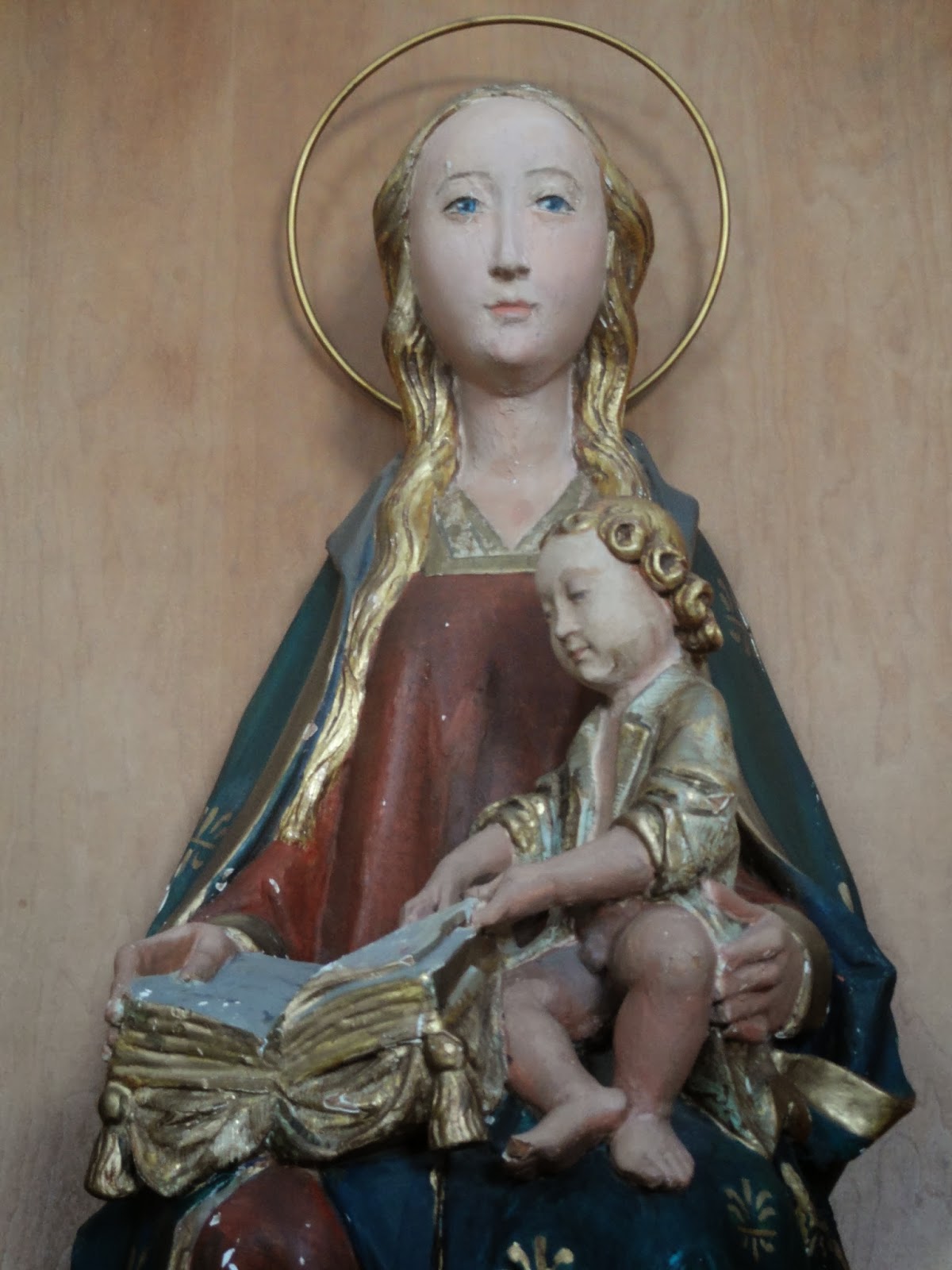
The grounds were very nice (and, obviously, completely covered with snow!).  Throughout the buildings there were various images of Our Lady, too, and so I took to snapping some pictures of them before I left.  I hope that you enjoy them!


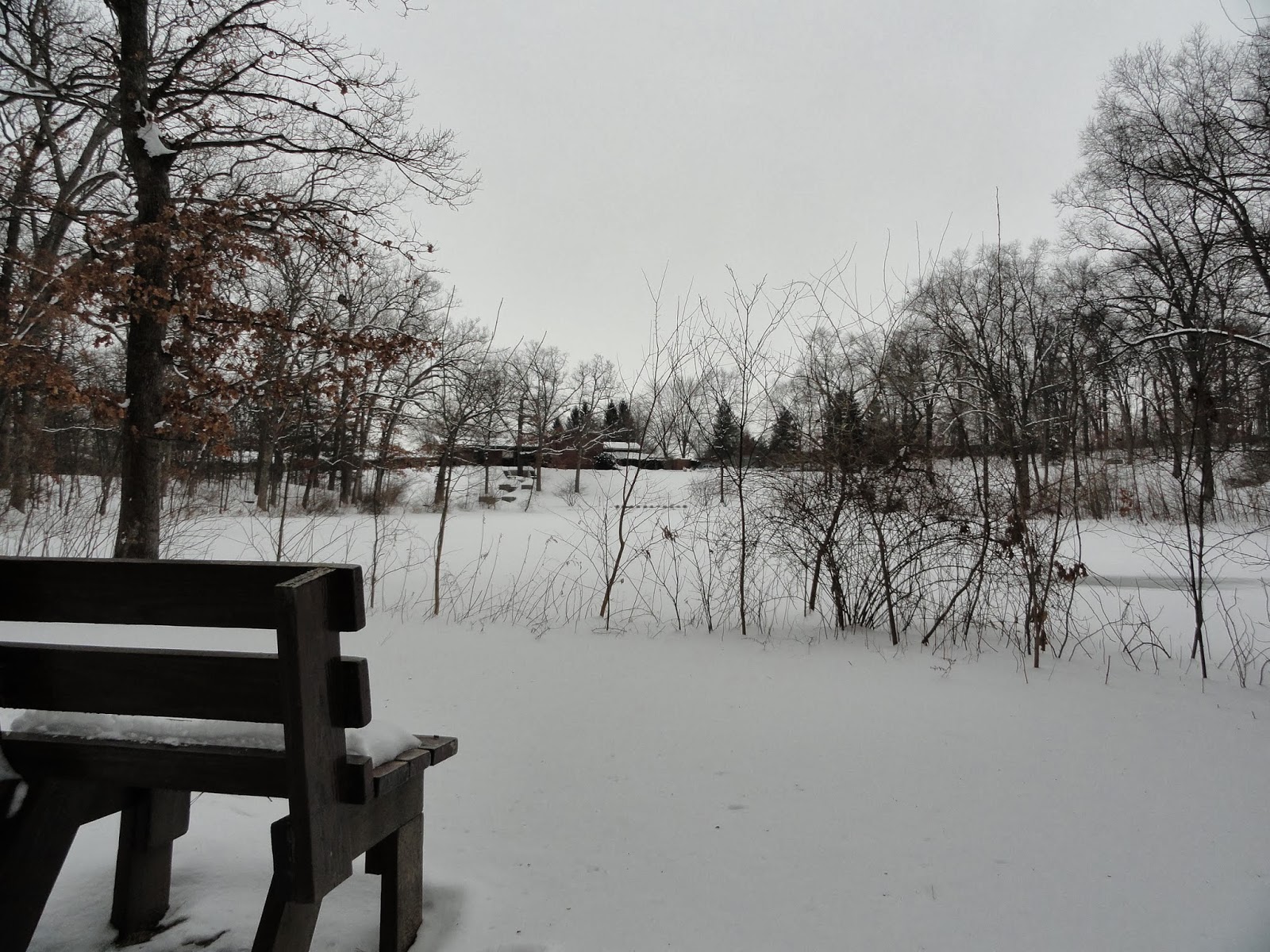
And then here are some images from around the grounds of the conference center.


More homilies to follow!

Tuesday, April 19, 2011

Mission: Retreat... Accomplished!

Greetings all in this holiest of weeks. Thank you for all of your prayers in the last week as I made my retreat. It was a blessed time of rest and restoration for me. I can't say that I had any great insights during the retreat, but rather I grew in confidence and conviction that this path that I have been on moving towards ordination is the path that God has laid out for me. The witness of the sisters was as much a source of meditation as was the Scriptures or the Rite of Ordination that I spent time with in their adoration chapel. To see so many women, young and old, who have given their lives completely to God reassured my faith that this step that I am about to take into consecrated ministry for the Church - while still a step into darkness, that is, into a mystery - is nonetheless one I can make boldly, trusting that God's love beckons me forth. The sisters are a witness to that love. Just as they stepped forth in love to return that love to God, so I know that I can step forth in the love I have for God. For all of this I can only give thanks, because I know that it is God who loved me first and it is the grace of the Holy Spirit that makes it possible for me to respond in love.

Tonight, we will celebrate the Chrism mass in Lafayette. It is the mass where the Bishop consecrates the sacred oils that will be used for the sacraments throughout the diocese in the next year (the chrism, the oil of catechumens, and the oil of the sick). It is a great event celebrating the unity of the diocese as representatives from each parish participate and receive the oils from the Bishop to take back to their parishes. It is also the mass where the priests of the diocese come together to renew their commitment to the priesthood. For me this will be another great witness as I prepare to enter into the Church's consecrated ministry. To see these men, young and old, renewing their commitment to the priestly ministry of Jesus Christ will be another sign of confidence that my love for God is real, and that my desire to step forth into this ministry is an authentic response to that love. If you've never had a chance to participate in an occasion such as this, I highly recommend doing so. It will strengthen your faith in God and in his church.

Thanks again for your prayers. As we approach the celebration of the greatest feast of the year (of all time, really), let us give ourselves more fervently to prayer so that on Easter day we will truly rejoice!