Showing posts with label satan. Show all posts

Sunday, March 1, 2020

Pop quiz for the 1st Sunday of Lent


[My format looks weird today because of the way that this homily was set up and presented.  It just worked better this way.  Sorry if it is hard to read in this format!]
Homily: 1st Sunday in Lent – Cycle A
          Okay, friends, today, on this first Sunday of Lent, we are going to shake things up a bit and start off with a little pop quiz based on the readings we’ve just heard.  Don’t worry about it, though, because you’re going to know most of the answers and there are no grades.  Ready or not, here we go!
  •         Is humankind responsible for the presence of suffering and death in the world, yes or no?  [YES]

o   Even though it wasn’t included in the reading today, we all know “the rest of the story”, that Adam and Eve were punished and expelled from the garden so that they couldn’t eat from the tree of life and, thus, would have to suffer death.
  •         Has humankind been able to eliminate suffering and death from the world, now that they are present in it, yes or no?  [NO]

o   Just look around.  Suffering and death are still very present here.

  •         Is there any reasonable hope that humankind will ever eliminate suffering and death from the world, yes or no?  [NO]
o   Suffering and death have been part of the human condition for as long as history has been recording it.
  •         Who is the only human being that ever existed who died, but then raised himself back to life?  [JESUS]
  •         Is it reasonable to expect that this could be possible for any human being ever, yes or no?  [NO]

o   Again, human beings have been around for 200,000 years and we ain't figured it out yet!
o   Why then do we stubbornly act like we will?  DON'T ANSWER THAT!
  •         If this Jesus has done something that no human being has ever been capable of doing nor will ever be capable of doing, then he must have super-natural powers (that is, powers beyond natural powers), true or false?  [TRUE]
  •         Since this Jesus has done something that no other human being has ever been capable of doing, something that we cannot reasonably expect any present or future human being as being capable of doing, is it, therefore, reasonable to think that this Jesus could also do the other thing that humankind has been incapable of doing: that is, is it reasonable to think that Jesus could also eliminate suffering and death from the world, yes or no?  [YES]

o   It is reasonable to think that because we don’t know the limit of his powers.
  •         Has this Jesus revealed the secret to unlocking resurrection (that is, the secret for overcoming suffering and death) for each and every one of us, yes or no?  [YES]
  •         What is that secret (hint: it’s in the Gospel reading today)?  [OBEDIENCE TO THE WILL OF THE FATHER.]

o   Saint Paul said it in his letter to the Romans:
o   “For just as through the disobedience of one man the many were made sinners, so, through the obedience of the one, the many will be made righteous.”
§  The one who was disobedient was Adam and we were reminded of that in our first reading today.
·        Eve said, “We may eat of the fruit of the trees in the garden; it is only about the fruit of the tree in the middle of the garden that God said, ‘You shall not eat it or even touch it, lest you die.’”
·        They ate it, in clear disobedience of God, and suffering and death entered the world.
§  The one who was obedient was Jesus and we were reminded of his first great act of obedience in our Gospel reading today.
·        Satan said to him, “If you are the Son of God, throw yourself down… Jesus answered him, …'You shall not put the Lord, your God, to the test.’”
·        Jesus countered Adam and Eve’s disobedience by his perfect obedience.
·        His final and culminating act of obedience was his passion and death.
  •         Friends, this is what Lent is about: returning to the garden through obedience.

o   If our Lenten practices are not freeing us to give our obedience more fully to the Father, then we should stop them and choose practices that will!
o   The first practice, of course, is giving up sin!
§  None of us should be giving up chocolate unless we have first decided to do the work of giving up sin!!!
o   Once we’ve done that, however, we take on physical discomfort (that is, giving up something good that we enjoy or taking up a good task that, perhaps, we don’t enjoy), so as to do two things: a) to show God that we are truly sorry for our sins, and b) to face our spiritual discomfort that God is calling us to still greater holiness (...a call, by the way, that never ceases!)
§  I think that we get “a)” no problem, but how many of us have ever really faced “b)”?
§  Not sure what I mean?  Let me give you an example. 
            Last Friday afternoon, I was working in my office and I had an e-mail that I had to write that was important and complicated to compose.  I was tired and really didn’t want to do it.  So there I am, staring at my computer screen, not wanting to do the thing that I knew I needed to do, and so what did I do?  Well, I opened up a new tab on my browser and hovered over the Facebook link.  Before I clicked on it, however, I remembered that I decided to fast from social media on Fridays during Lent and so I stopped myself and went back to my e-mail.  Soon, though, I was in a new tab hovering over the Facebook link again.  Once again, though, my commitment to what I was giving up one over and I went back to my e-mail.  Finally, I dug in and wrote the e-mail.  The point being that, if I hadn’t chosen to give up a physical comfort (checking out what was going on with my friends on Facebook), then I wouldn’t have confronted my spiritual discomfort (completing the work that I had been given to do).  Fasting from social media, therefore, showed both that I was sorry for my sins and made it so that I could confront this spiritual battle.
o   We have to give up sin, of course, but then we should give up (or take up) something good, both to show God that we are truly sorry for our sins and to face our spiritual discomfort that God is calling us to greater holiness and so put ourselves to work to do it!
§  THIS, in a nutshell, IS OBEDIENCE!!!
§  Obedience, Jesus has shown us, leads to resurrection and eternal life.
          Okay, a couple of more questions a then we’ll call it a day.
  •         Is Jesus still alive, yes or no?  [YES]
  •         Will we meet him, face-to-face, one day, yes or no?  [YES]
  •         What, then, should we do during Lent?

o   A question you must answer yourself.
o   Whatever your answer is, it should be something that leads you to deeper obedience to the will of the Father so that, when Easter comes, you’ll be ready to die with Christ and so rise with him again.
Given at Saint Mary’s Cathedral: Lafayette, IN – March 1st, 2020

Sunday, June 10, 2018

Satan's most dangerous attack


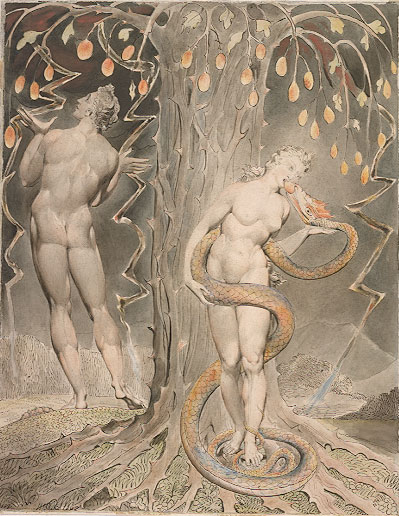
Temptation and the Fall of Eve by William Blake
Homily: 10th Sunday in Ordinary Time – Cycle B
          Although we’ve been back in “Ordinary Time” for a couple of weeks now, we’ve been occupied with the celebrations of Trinity Sunday and Corpus Christi.  This weekend, we celebrate the first “ordinary” Sunday in Ordinary Time since February 11th.  As we know, Ordinary Time is the time for us to focus on growing as disciples of Christ.  One of the ways that we do that is to identify and remove any obstacles to our discipleship.  Interesting, therefore, that our scriptures today speak a lot about the enemies of God and their influence in the world.  Perhaps, therefore, we can take a moment to talk about the ways that Satan attacks us.  In doing so, hopefully we’ll all be a little less fearful of these ways and, thus, strengthened to resist Satan and his influence as we strive to grow and live as disciples of Christ.
          Satan attacks us in many ways: some of them quite dramatic and frightening.  The rarest, yet most dramatic of these of is demonic possession.  This is where an evil spirit gains access to control a person’s body.  Almost always this occurs when someone gets involved with the occult, spiritsm, or witchcraft (Ouija boards included!).  There’s the old legend that a “vampire can’t enter your house unless you invite him.”  The invitation that one gives to an evil spirt isn’t always explicit, but when participating in these “dark arts” activities, the door is opened and a “Welcome” mat is laid out.
          One who has been possessed by an evil spirit will then begin to experience “crises”, in which the evil spirit temporarily takes control of the person’s body and can manifest certain phenomena, such as: extraordinary physical strength and speaking and understanding languages that the person never studied.  To free the person of this evil spirit, the Church offers exorcism.  Exorcism consists of a series of prayers and sacramentals performed by a priest who has been specially trained and designated by the bishop.  This ritual makes the demon suffer so much that, eventually (and if the person is cooperative) the demon will just give up and leave.  Although Hollywood tends to overdramatize the acting out of these rituals, they are, nonetheless, dramatic.  Thankfully, however, the need for such exorcisms is much rarer than Hollywood would like you to believe.
          Besides possession, there are also some other extra-ordinary ways that Satan attacks us.  Sometimes, Satan and his fallen angels cause frightening physical disturbances in certain places or even to our own bodies.  These can take the forms of loud or strange noises, slamming doors or windows, being moved around physically by an invisible force, or even more alarming effects.  When these physical disturbances are concentrated in certain places (a home or a room), they are called demonic infestation.  When they directly affect someone's body (not from within, as in possession, but from the outside) they are called demonic oppression.  When they bother someone's mind (filling it constantly with blasphemous thoughts), they are called demonic obsession.  Blessings, holy water, and other prayers and sacramentals are strong defenses against these kinds attacks.
          These extra-ordinary kinds of attacks are, of course, dramatic and frightening.  But they are much, much less frequent, and much, much less dangerous than the Satan’s favorite tactic for attacking us.  What is it?  Temptation.  While possession, infestation, oppression, and obsession can frighten us (and potentially cause us to lose faith in God), they usually lead us to exercise our faith in order to be rid of them.  Temptation, on the other hand, tries to lead us into sin; and sin is the only thing that separate us from God.  Thus, while much less frightening (in fact, it’s often quite the opposite!), temptation is much more dangerous.
          If we need an example of this, just look at Adam and Eve.  Satan did not possess them, he did not make the trees dance around inexplicably, he didn’t bully them (pushing them around or disturbing their sleep), and he didn’t assail them constantly with thoughts of cursing God.  Rather, he tempted them.  He tempted them to doubt God’s truthfulness and they took the bait.  Having no other reason to keep from eating the fruit of that tree than that God had said not to, Eve perceived no harm could come from it and so took the fruit and ate it; and Adam after her.  Their blindness then removed, however, they could see the truth of what had happened and so felt ashamed.  When God came looking for them, they hid not because they were naked (although that is the excuse Adam used), but because they didn’t want to face God, whose trust they had betrayed.
          What happens next in the reading, however, leaves me feeling a bit jealous of Adam and Eve.  God’s punishment against the serpent was that there would be “enmity” between him and Eve: meaning that Eve would now be frightened to see the serpent, so that she would never trust him or his temptations ever again.  In other words, Adam and Eve would know their tempter and so be better equipped to resist the temptations.
          We are not so lucky.  When we are tempted, quite rarely is our tempter visible to us.  If he is, it is usually someone who seems rather friendly or trustworthy.  It would be so much easier if all our tempters were repulsive to us, right?, like the serpent was made repulsive to Eve.  Still more, because of our fallen nature, we suffer from a disordered desire for the things of this world (which our tradition calls “concupiscence”).  In this case, all we have is the forbidden fruit before our eyes, which looks “pleasing to the eyes”, and which, perhaps, has never been explicitly declared to be “forbidden”, and an urge to take it.  Adam and Eve had a lot more going for them and they still fell into sin.  Given our situation, then, our efforts to resist temptation might seem hopeless.
          For the Christian, however, it is not hopeless; and Jesus’ parables in the Gospel reading show us why.  In today’s reading, Jesus was accused of being possessed by the devil or being in “cahoots” with the devil himself.  Jesus condemns those calling him possessed: for in calling him “possessed by an evil spirit”, they were accusing the Holy Spirit of being evil (which is the unforgivable “sin against the Holy Spirit” about which he spoke).  Then he gives two parables to prove that he is not on Satan’s “team”, but rather stands against him.  The first using logic to say that a kingdom divided cannot stand; and so, if he is on Satan’s “team”, then don’t worry because Satan will soon fall.  The second to illustrate what he is actually doing:  Jesus is the one who has come to tie up the “strong man” (that is, Satan) so that he could “plunder his property” (that is, take back the souls of God’s children).
          This, then, is the reason for our hope: that when we can’t see the tempter working his wiles on us (either because he takes the form of someone seemingly trustworthy or because he introduces sinful thoughts), we nonetheless have the power of Christ available to us and his example of self-sacrifice to guide us to choose God’s will over our own, sinful inclinations.  Christ will bind the “strong man” once again when we call on him in temptation so that we might be liberated from his grasp.
          Still, we have to do our own work: that is, we must pray, frequent the sacraments (especially the Eucharist and Reconciliation), and we must practice virtue in our daily actions.  In doing these things, temptations will become increasingly repulsive to us, because we will be seeing the one who is tempting us, the serpent from the Garden, and we will be strengthened to overcome them.  This, my friends, is our “Ordinary Time” work: to make temptations repulsive so that we can stay focused on Jesus.  Let us take up this good work, then, trusting that God, who has begun this good work in us, will bring it to completion.
Given at All Saints Parish: Logansport, IN – June 9th & 10th, 2018

Monday, February 15, 2016

Checking your reality

Homily: 1st Sunday of Lent – Cycle C
          An African Impala is a grazing antelope that stands, on average, about four feet tall at the shoulder.  As suggested by its size, it is quite nimble, but also powerful.  Impalas have been known to jump up to 10 feet in the air (that’s the height of a regulation basketball hoop, by the way) and can long jump up to 30 feet (which is world-record length for human long jumpers).  Because of this, you might think that it would be quite hard to contain an African Impala.  Well, not really.  You see, an African Impala has a bit of an “Achilles’ heel” in that it will not jump unless it can see where it is that it is going to land; and so a solid fence of about five or six feet is generally enough to pen in an Impala.
          That seems silly, right?  Well, for us, sure.  We can look around and say “Hey, that’s a fence; usually there is more of the same on the other side and so, if I am standing on something solid and I jump it, I should have something solid on which to land on the other side.”  An Impala, however, is not intelligent in that way—it can’t reason like we do—and so it can only go on what its instinct tells it; and its instinct says, “Hey, if you’re going to jump 10 feet in the air, you better be sure that there’s something solid on which to land on the other side.  Otherwise it’s ‘game over’ for you.”  It can’t know the reality that it can’t see; and so, in spite of its impressive power, it can get trapped by a simple fence.
          As human beings, we can see beyond the empirical: that is, beyond those things that we can see, touch, taste, hear, and smell.  In other words, we have the ability to reason abstractly about situations and find solutions that other animals would not be able to find.  This is a great gift that God gave to us when he made us “in his image”.  Because of this, how we conform ourselves (or fail to conform ourselves) to reality has moral consequences.  We may blame the African Impala for “being stupid” because it gets trapped by a fence that it can easily jump over, but it could not choose whether or not it would be “stupid” (that is, “unintelligent”) and so applying a value judgment (that is, to say that it was either “good” or “bad”) is inappropriate.  We, however, are intelligent creatures; and so if one of us was penned in by a fence that we could easily hop over, we could rightfully blame that person for “being stupid”, that is, “unintelligent”, because he or she has the ability to know about reality beyond what the senses immediately perceive.  Now, when we apply this logic to the reality of what God has revealed to us, we come to know what it means to sin.
          Sin, using the line of thinking that we’ve just been using, is our deliberate refusal to conform ourselves to reality: both the reality that our natural senses present to us as well as the reality that God has revealed to us.  For example, let’s go back to the first sin.  Adam and Eve were in the Garden and God told them that they could eat of any tree in the Garden, except the one in the center of the Garden; and that if they ate the fruit of the tree in the center of the Garden they would die.  No problem, right?  There’s plenty of fruit in the Garden and so there’s no need to consider the fruit from the tree in the center of the Garden.  That’s when Satan comes and tempts Eve.  He challenges Eve to question the reality that God revealed to her: that if she ate of the fruit of that tree—fruit which looked pretty much like any other fruit in the Garden—she would die.  Eve, relying only on what she perceived by her natural senses, ignored the reality revealed to her by God—that, in spite of its looks, and in spite of what Satan told her about it, eating of that fruit would be deadly—and thus she condemned the human race to death when she took the fruit and ate it.
          This, of course, is the same scene playing out in the Gospel reading today.  Jesus, having just been baptized by John in the Jordan River, is driven by the Holy Spirit into the desert where he would pray and fast for 40 days.  At the end of that time, Satan comes to tempt him to conform himself to three false realities.  First is that power is given to man so that he can satisfy all of his bodily desires.  This is the temptation to change rocks into bread.  Second is that man’s capacity to worship is meant for our own gain.  This is the temptation to worship Satan so as to gain power over the nations of the world.  Third is that man’s status in God’s eyes makes God his servant, at his beck and call.  This is the temptation to put God’s promises to the test (saying, in effect, “Watch, I’ll make God do something for me.”).
          Jesus contradicts the proposed false realities by naming the true realities that God the Father had revealed.  Against the first temptation Jesus replies, “It is written, ‘One does not live on bread alone’”, meaning: “Power is not given to man so that he might satisfy his bodily desires”.  Against the second temptation Jesus replies, “It is written, ‘You shall worship the Lord, your God, and him alone shall you serve’”, meaning: “Worship is what we owe to God, because of his mercy to us, not as a way to get something for ourselves.”  Finally, against the third temptation (in which Satan tries to use Jesus’ tactic of quoting Scripture) Jesus replies, “It also says, ‘You shall not put the Lord, your God, to the test’”, meaning: “The promises of God are not a license to be stupid, but a divine guarantee of protection in trial.”  In responding in this way, Jesus not only conforms himself to the reality that that he perceives through his natural senses, but more importantly he conforms himself to the reality that God the Father has revealed; and, thus, in stark contrast to Eve, he keeps himself from sin.
          My brothers and sisters, this Gospel reading is set before us on this First Sunday of Lent to remind us that Lent is a yearly “reality check” of sorts.  It is a time in which we are called to examine our lives in order to see whether or not we are living according to the reality both that our natural senses perceive and that God has revealed to us, or if we have given ourselves over to a false reality that Satan has presented to us.  Sin is choosing that false reality over the true one.  If we find that we are living according to a false reality, Lent is our time to turn away from that reality and to turn ourselves back to the true reality.
          And this shouldn’t be scary!  Remember, the fence beyond which the African Impala cannot see presents a false reality that there is nothing on the other side; and so it becomes trapped by conforming itself to that reality.  The true reality—that the same solid ground on which it is standing is waiting for it on the other side of the fence—would actually free the Impala; because then it could, with confidence, leap over the fence into freedom.  When we acknowledge the false realities by which we have been living, we then see that they have been confining us and, thus, we can leap beyond them into freedom.
          And so, how do we check our reality?  The same way that Jesus did: by knowing the Word of God as revealed to us in Sacred Scripture and the Tradition of the Church.  If how you are living your life does not conform to the realities that God has revealed to us both in Sacred Scripture and in the Tradition that has been handed down to us through the Apostles and their successors, then you are living (in part, at least) in a false reality: a fence, set up by Satan, to keep you from experiencing the true freedom that God desires you to know.  Lent, my brothers and sisters, is our time to acknowledge those fences for what they are—false realities that trap us into death—so that we can be prepared to be renewed into the truest reality of them all: that we who have been baptized into the death of Jesus have risen with him into new life; the very same life that he now lives and that we encounter under sacramental signs here in this Eucharist.
          Let us, then, take up this good work of Lent; so that on Easter Sunday we may truly glory in the reality of our Lord’s victory over sin and death and enjoy once again the true freedom of the sons and daughters of God.

Given at All Saints Parish: Logansport, IN – February 13th & 14th, 2016